You might have often been told by your parents or elders not to question the existence of God or the validity of scriptures. In many modern households faith is often equated with silence and piety is measured by how quickly one accepts dogma without a murmur of doubt.
But what if I told you that this passive acceptance is actually a deviation from the very tradition it seeks to protect? If you look back into the intellectual history of ancient and medieval India you will find that criticism was not considered a sin. It was a sacrament.
The greatest thinkers did not just pray.
Related Posts:

They argued.
They did not just accept.
They dissected.
When we hear the word criticism today we often interpret it as a negative attack or an insult but in the philosophical tradition of Vada or debate criticism was the highest form of respect. It meant that your idea was worthy of being tested in the fire of logic.
Consider the irony of Sage Kapila. In the Bhagavata Purana Kapila is celebrated as one of the twenty four avatars of Vishnu. He is divine and revered and worshipped. Yet do you know that his Darshana the ancient Sankhya system was taken apart by Badarayana who is traditionally identified as Veda Vyasa himself?
Think about that for a moment. You have Vyasa the compiler of the Vedas refuting Kapila an avatar of Vishnu. In any other culture this might be seen as blasphemy but here it was seen as the necessary evolution of thought. This clash is not just a historical footnote. It is the story of how human consciousness moved from analyzing the world with eyes wide open to realizing the self with eyes closed.
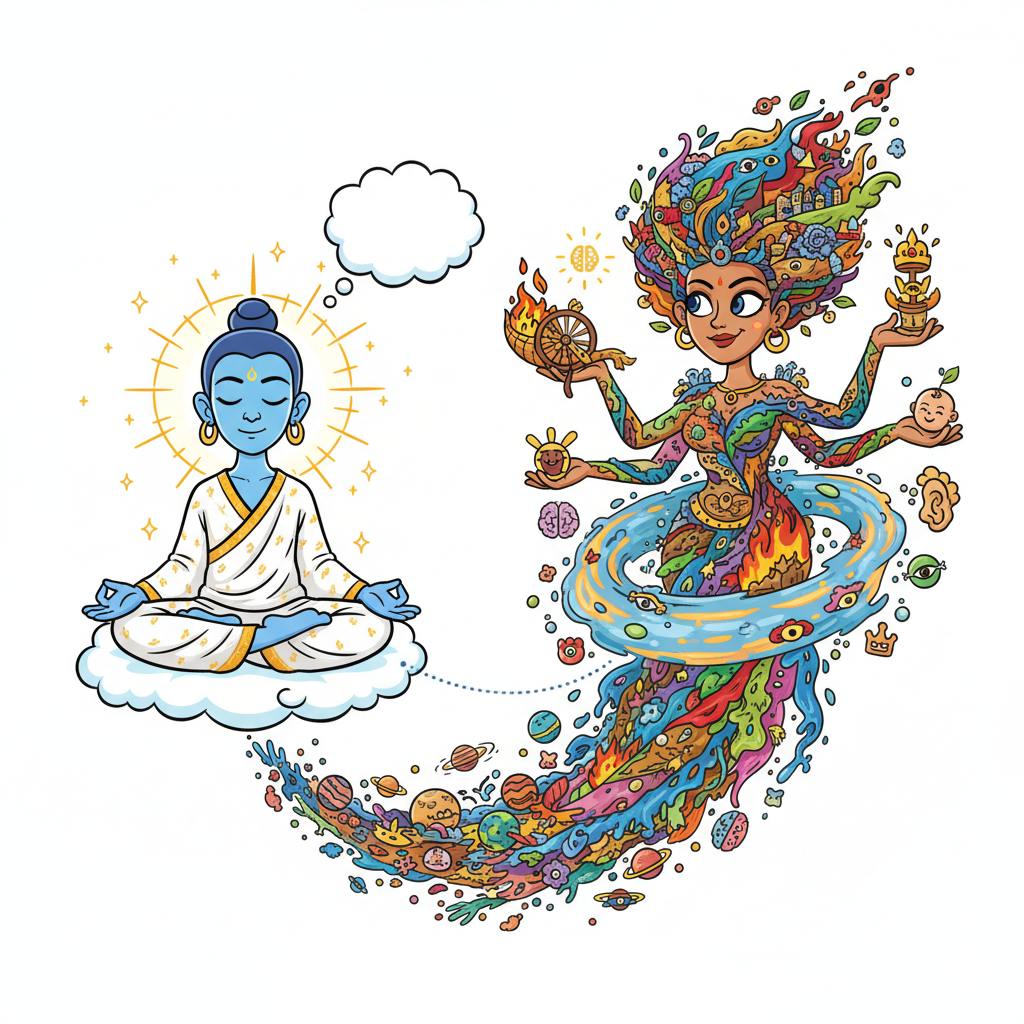
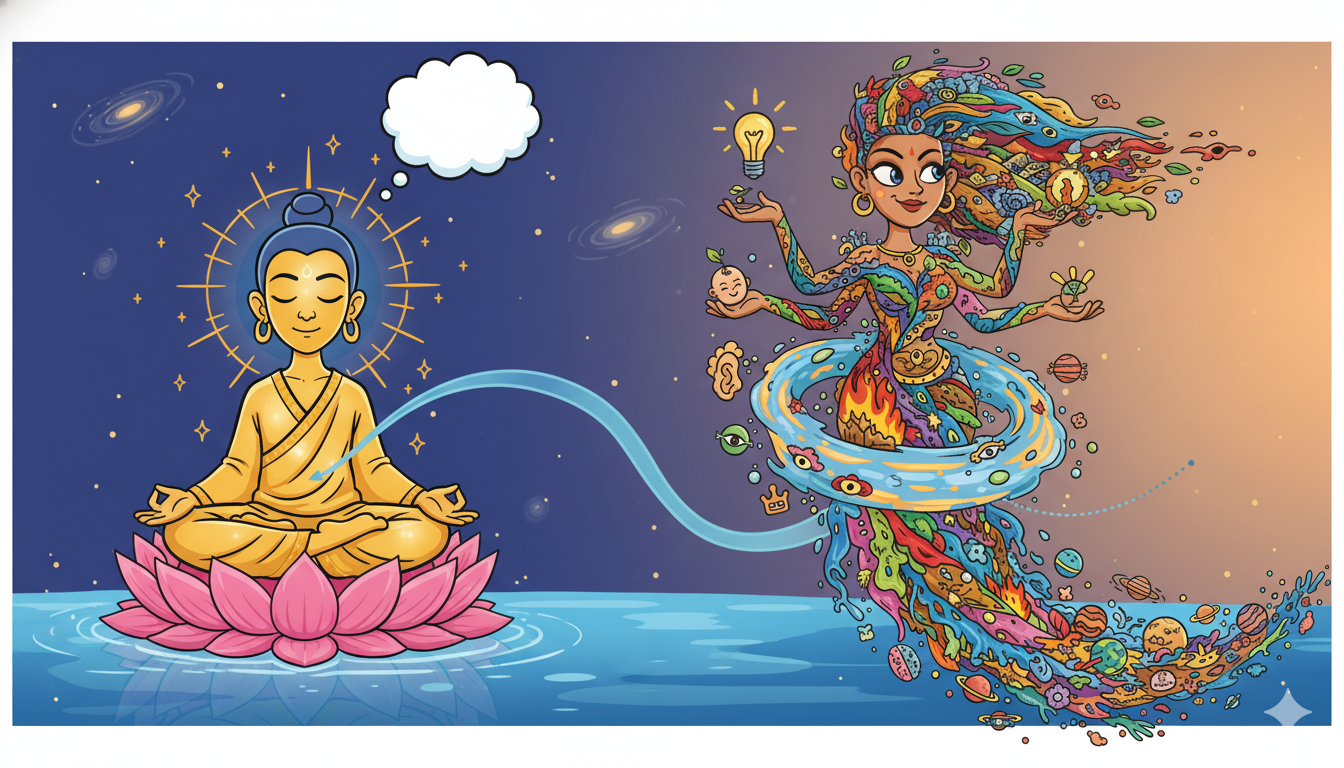
To understand this we have to look at what Kapila actually proposed. Sankhya is often called the philosophy of numbers or enumeration because it breaks reality down into twenty five specific categories or tattvas. It is a dualistic system. It says that reality is made of two distinct and eternal entities. On one side you have Purusha the silent and unchanging witness or consciousness. On the other side you have Prakriti the dynamic and creative force of nature. In Sankhya the Purusha is like a man with a lamp and Prakriti is the dancer performing in the light. The man watches but he does not dance. He is separate.
This approach is what we might call the Open Eye method. It looks at the universe and takes it apart piece by piece to see how it works. People often misinterpret Sankhya as being just about physical matter like a primitive form of physics but it is actually a profound text on consciousness and perception.
For instance have you ever wondered how the elements interact with your senses?
Sankhya says that the physical elements or Maha bhutas are born from subtle perceptions called Tanmatras not the other way around.
So think of Sankhya to be applicable for people who live in Samasara.
It offers a fascinating evolution of matter that maps perfectly to our sensory experience. It starts with Sound or Shabda. From the potential of sound comes Space or Akasha. This is the most subtle element. Then we add Touch or Sparsha. When you combine Sound and Touch you get Air or Vayu. If you add Form or Rupa to the mix you get Fire or Agni. Add Taste or Rasa and you get Water or Jala. Finally if you combine all five Sound Touch Form Taste and Smell or Gandha you get Earth or Prithivi. This is not just a chemistry table it is a map of human experience. You can even see this in the framework of the Chakras rising from the Earth element in the Muladhara to the Space element in the Vishuddhi. It is a brilliant and analytical way of seeing the universe through consciousness perspective. It tells you that the world is real the parts are distinct and you are the witness standing apart from it all.
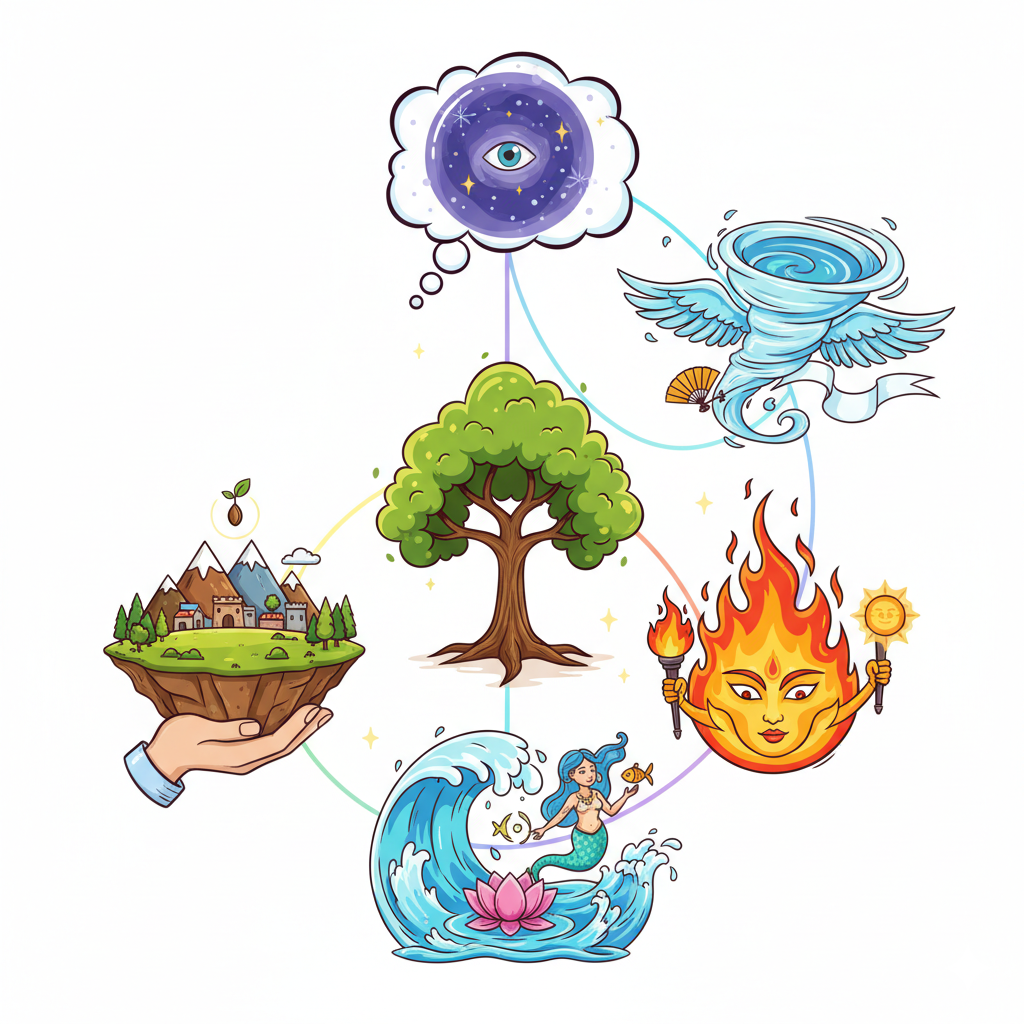
But then comes Badarayana with the Brahma Sutras and he essentially says that this model is incomplete. This is where the Closed Eye of Vedanta begins to challenge the Open Eye of Sankhya. The primary point of contention lies in the cause of the universe. Sankhya argues that the universe evolves out of Pradhana or unmanifest matter largely on its own like milk spontaneously turning into curd. They argue that you do not need a God or a conscious supervisor for nature to do its work. Nature is designed to evolve.
Badarayana attacks this specific point in the Brahma Sutras specifically in the famous aphorism 1.1.5, iksater nasabdam. The phrase essentially means that the First Cause cannot be inert matter because the Vedas speak of Seeing or Willing. The scripture says Tadaikshata which means It saw or It thought.
It says, inert matter no matter how complex cannot have the intention to create. It cannot see the future universe it is about to build. Therefore the cause of the universe must be a conscious entity which is Brahman not a blind and mechanical force like Prakriti.
He goes further in later sutras such as rachananupapattesca nanumanam which questions the logic of design. If you look at the complexity of the universe the intricate design of a flower or the motion of the planets can this really be the result of blind matter moving by accident? Badarayana argues that design implies a designer. Just as clay cannot shape itself into a pot without a potter Pradhana cannot shape itself into a universe without the will of Brahman.

This leads us to a crucial distinction in how these two schools handle the world. Both ask us to use discrimination or Viveka but the flavor is different. In the Sankhya path the goal is to manage well with freedom. The Sankhya Yogi looks at his anger and says this anger is real because it is a product of Nature or Prakriti but I am the Purusha and I am distinct from it. It is like oil floating on water. The water is real and the oil is real but they do not mix. The Sankhya Karika uses a phrase very similar to negation called Nasmi Na me Naham which means I am not this this is not mine I am not the doer. It is a psychological distancing. You step back from the machinery of the world acknowledge its reality but refuse to touch it. You become the silent witness in the theatre watching the play but never stepping onto the stage.
Krishna in Bhagavat Gita also gives good importance to Sankhya.
Vedanta however takes a much more radical step. This is where the famous Neti Neti or Not this Not this comes in. The Vedantin does not just distance himself from the anger he questions the reality of the anger itself. He says this anger has a name and a form so it is a product of Maya. It is an illusion superimposed on the Self. For the Sankhya philosopher the world is a trap made of iron bars. You have to squeeze through them to get out. For the Vedantin the trap is made of smoke. You do not squeeze through it you blow it away with knowledge. This is why Neti Neti is associated with Vedanta and Maya. If Prakriti were truly real as in Sankhya you could not negate it away you could only detach from it. But because Vedanta sees Prakriti as Maya or dependent reality it can be negated entirely until only Brahman remains.
In Sankhya the observer is different from the observed. In Vedanta the Observer is the Observed. This is the non dual reality. When you close your eyes in meditation according to Vedanta you are not trying to separate yourself from the world you are trying to realize that the world arises within you. The causality chain reverses. It is not that elements create the body and then consciousness inhabits it. It is that Consciousness imagines the elements and the world appears.

So the next time someone tells you not to question remember the great debates of the past. Remember how the Brahma Sutras fearlessly challenged the dualism of Sankhya to pave the way for the non dual realization of Advaita. We need the Open Eye of Sankhya to understand the laws of nature to do our science to map our chakras and to understand our psychology. But ultimately we need the Closed Eye of Vedanta to merge that understanding into the unitary experience of bliss. The journey of Indian Darshanas isn’t about blindly following one path it is about climbing the ladder of logic until you reach the silence beyond words.
Have you thought about which eye you are using to look at the world today? Is it the eye that divides and analyzes or the eye that unifies and transcends? Perhaps like the sages we need to master both.