Have you ever stopped to consider just how thin the line is between advanced mathematics and pure magic? We often think of science as a rigid, step by step ladder of logic, but every now and then, humanity stumbles upon a discovery that feels less like a step forward and more like a teleportation. We are living through one of those moments right now.
Consider the recent numbers coming out of the world of quantum computing. Specifically, look at the performance of the new Willow chip. The comparison between this chip and a standard supercomputer is not just a matter of speed. It is a matter of incomprehensible scale. To solve a specific complex benchmark, the Willow chip took five minutes. A standard supercomputer, running the same task, would take ten septillion years. That is a one followed by twenty five zeros.
To put that into perspective, our universe is only about thirteen point eight billion years old. A conventional computer would need to run for trillions of times the current age of the universe to finish what this quantum chip finished while you were brewing your morning coffee. When the gap is that massive, logic starts to feel a bit wobbly. How can a machine perform a calculation that technically requires more time than time itself allows?
Related Posts:

This is where the story gets interesting, and frankly, a bit strange. There are two main ways physicists try to explain this “magic,” and both of them force us to question the nature of reality itself.
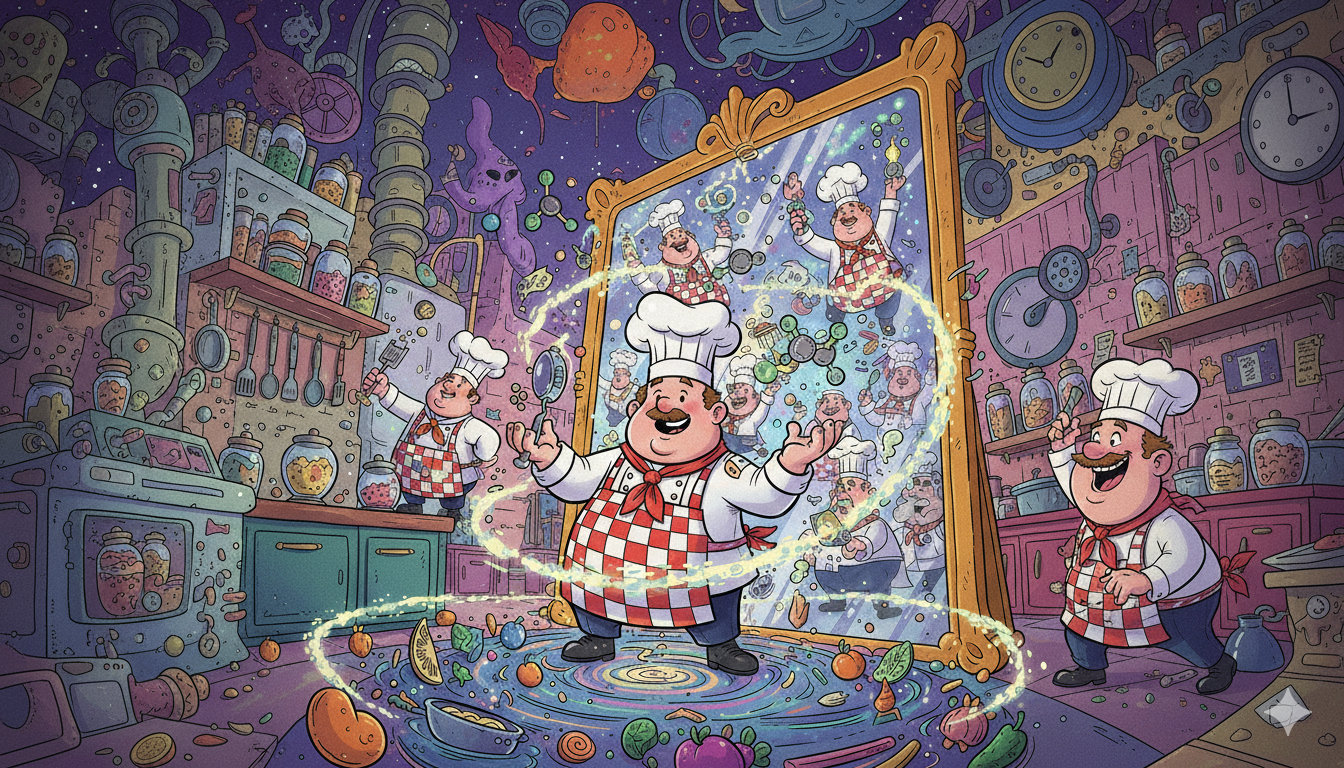
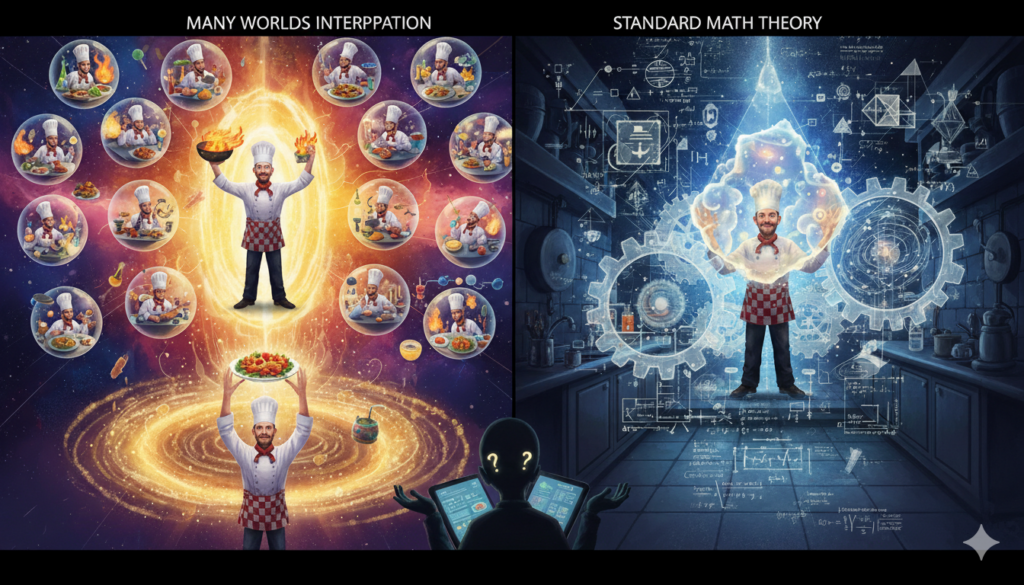
First, there is the “Many Worlds” interpretation. Imagine a chef trying to find the perfect recipe. A normal computer is like a single chef who tries one recipe, tastes it, throws it out, tries another, and repeats this process billions of times until they find the winner. It is slow and linear. But a quantum computer? The Many Worlds theory suggests that the moment the chef starts cooking, they split into a million versions of themselves in a million different kitchen bubbles. Each version tries a different recipe simultaneously. Once the winner is found, all those realities collapse back into ours, presenting us with the answer instantly. It sounds like science fiction, but serious physicists argue that for a computation to happen that fast, the work has to happen somewhere. If our universe does not have the “room” for that much math, perhaps it is being outsourced to parallel versions of reality.
The alternative view is less cinematic but equally mind bending. This is the “Standard Math” theory. It suggests we do not need a multiverse. Instead, we need to accept that quantum particles can exist in a “blurry” state, holding massive amounts of information in a hidden mathematical layer called Hilbert Space. It is not that the computer is in another world. It is that the fundamental building blocks of our world are far more complex and capable of interaction than we ever realized.
But here is the question that really matters. Whether it is parallel universes or hidden dimensions, we have entered an era where we can manipulate the fabric of reality to crack encryption, simulate medicines in seconds, and create materials we have never dreamed of. Yet, the people designing these systems often cannot pinpoint exactly why they got the answer so fast. The “how” remains elusive.
If we can build machines that tap into the hidden layers of the universe, why are we still so baffled by the hidden layers of ourselves?
This brings us to the great divide between our technological explosion and our understanding of consciousness. We have mastered the external world, the “Bhu” and “Bhuvar” Lokas of shared physical existence. We have expanded horizontally, creating more experts, more users, and more technical wizards. But have we expanded vertically? Have we elevated our consciousness to match our computing power?
Even with quantum mechanics opening the door to the role of the observer, we hit a hard wall when we try to map these forces to the human experience. We struggle to understand how electromagnetic waves, which are just bundles of photons, couple with “consciousness waves.” How do these external forces connect to the Prana, the life force within us?
There is a physical barrier here that is difficult to cross. In our standard terrestrial environment, electromagnetic waves are limited by energy. We know about high frequency gamma rays, but if you push the frequency higher, you eventually hit the Planck Scale. At this level, the laws of physics as we know them begin to dissolve. The energy becomes so concentrated that the smooth fabric of space time breaks down. The very concept of a wave might cease to exist.
Perhaps it is at this threshold, where physical laws crumble, that the bridge to higher consciousness begins. It is speculation, of course, but one could imagine that processes at this scale become infinitely more complex. This might be the realm where the meditative stillness of a Yogi’s mind tunes into higher frequency waves. It suggests that there are “frequency realms” or Lokas that function like those proposed multiverses, operating with different fundamental constants.
So why haven’t we mapped this yet? Why is there no “Google Earth” for the psyche?
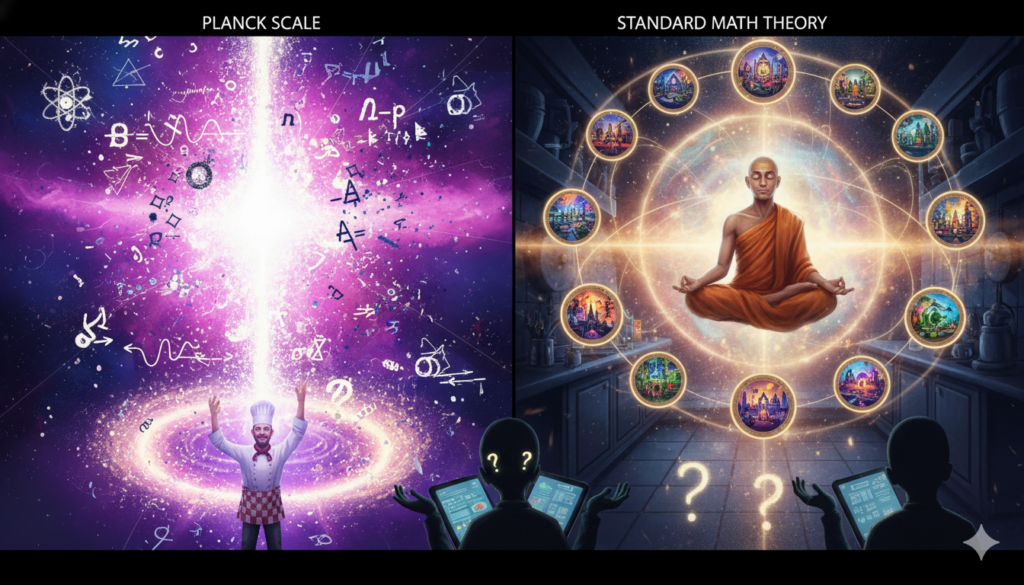
The problem lies in our methodology. Science, as we usually practice it, is a third person discipline. It requires external, measurable instruments. It demands that I stand here and measure that object over there. But the study of consciousness, or Yoga Vedanta, is a first person science. It is a trained introspection where the observer becomes the instrument. This is what we call Phenomenology.
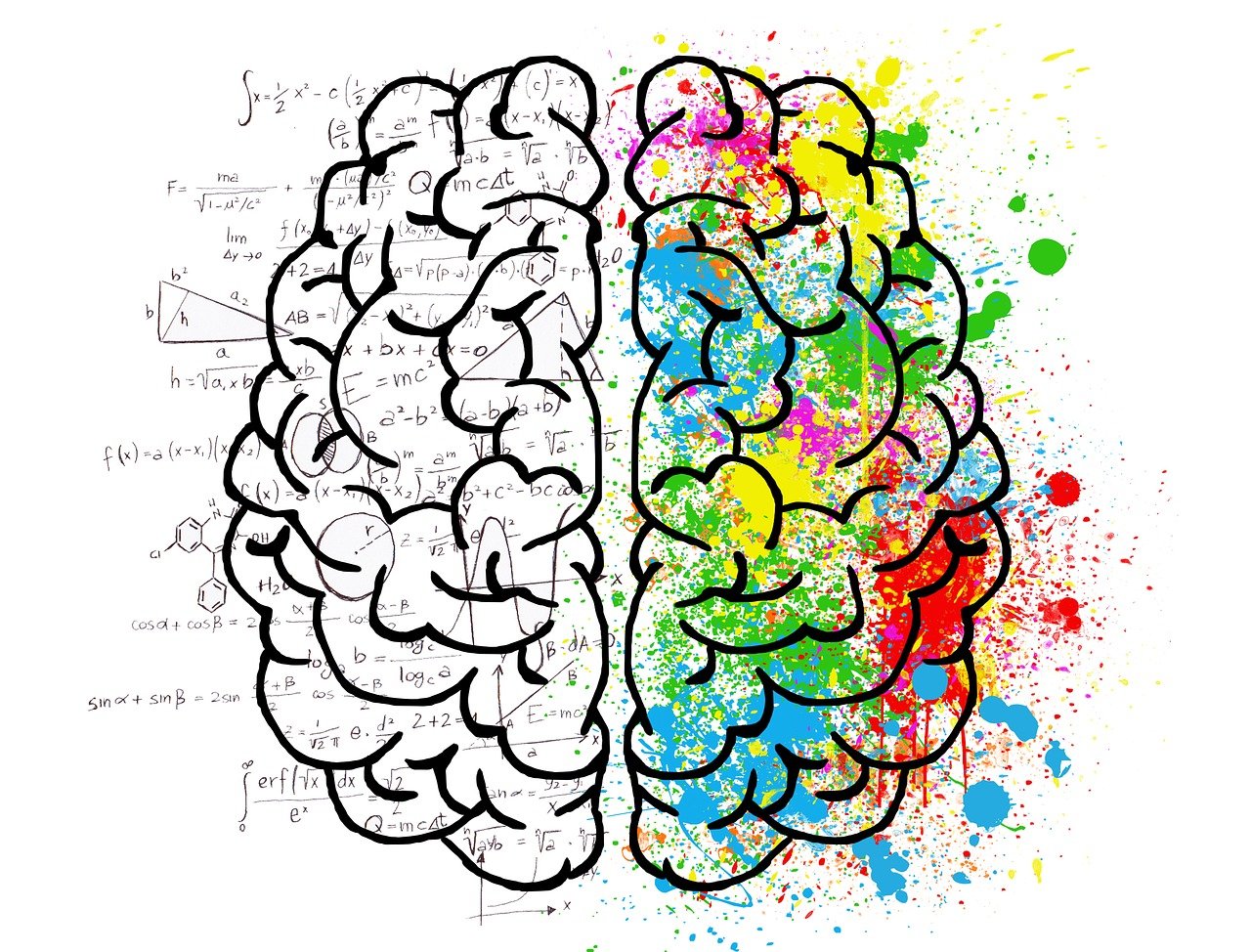
To modern science, this feels “purely subjective” and therefore unreliable. But that is a dismissal we can no longer afford. If we want to understand the “magic” of the quantum world, we might need a new kind of mind to study it. We are used to the “T shaped” mind, someone with deep expertise in one narrow field. But to bridge the gap between the physics of the Planck scale and the metaphysics of the Prana, we need “M shaped” minds.
Think of figures like Leonardo da Vinci or J.C. Bose. Bose was a physicist, a biologist, and a writer. He did not see boundaries between the living and the non living, or between science and literature. He saw different paradigms of the same truth. An M shaped mind can span multiple peaks of knowledge, connecting the dots that a specialist would miss.
This type of mind understands that subjective experience can be modeled. It treats inner experience as real data, not just noise. If every subject’s experience is different, that is not a failure of the model. That is novelty. That is data. We already measure brainwave patterns like alpha and gamma waves. The next step is to create a documentation framework that respects the replicability of inner states just as we respect the replicability of a chemical reaction.
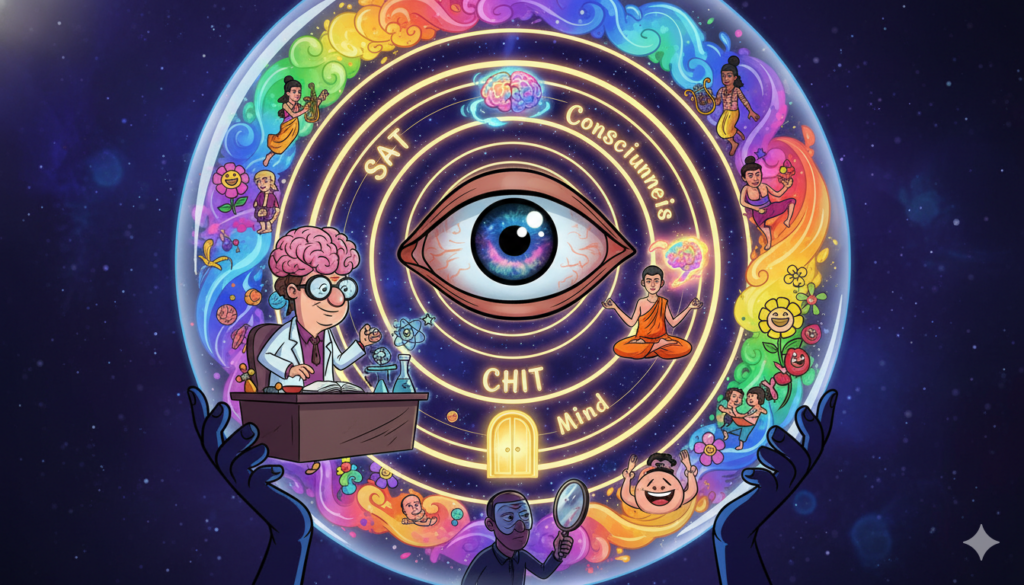
However, there is a word of caution we must heed. There is a danger in trying too hard to equate modern quantum physics with ancient wisdom. Science is a restless creature. It changes its mind. It evolves. Concepts of force and energy that were absolute truths a hundred years ago are nuanced questions today. If we tie the eternal truths of the “Sat Chit Ananda” (Existence Consciousness Bliss) to the current scientific theory of the week, do we not demean the eternal?
Science deals with the physical domain, the “Sat.” It is still fumbling in the dark regarding consciousness (“Chit”) and is galaxies away from understanding bliss (“Ananda”). Reducing the Atman, the eternal self, to a quantum fluctuation might be a mistake. The Atman is the identifier, not the identified. It is the eye that sees, not the object that is seen. The moment you identify it, you have pulled it into the realm of Maya, or illusion.
And yet, the paradox remains. We are material beings seeking non material truths. We are finite minds trying to grasp the infinite. This brings us back to the power of the question itself. In ancient texts, the syllable “Ka” represents the question “Who?” or “What?”. It is said that “Ka” itself is a form of the highest spirit.
Perhaps the answer isn’t in finding the final equation that explains everything. Perhaps the answer is in the cycle of questioning. We look at the quantum chip and ask “How?” We look at the stars and ask “Where?” We look inside and ask “Who?”
We are currently standing at a fascinating crossroads where the silicon of our computers and the carbon of our brains are starting to ask the same questions. We may find that the multiverse isn’t just out there in the math of a quantum processor. It might be right here, hidden in the frequencies of our own awareness, waiting for an M shaped mind to find the key.
