
Have you ever wondered why akasha, the space element in Bharatiya tradition, carries sound as its defining quality? In the scheme of five elements, akasha is the subtlest of all, the one nearest to pure consciousness, and every text agrees that its guna, its defining quality, is Shabda.
Why should something as vast and empty as space be forever paired with sound?
And why does Brahman, the very ground of universal consciousness, get called Shabda Brahman, as if the absolute itself were made of sound?
Related Posts:


These are not idle questions. They point to something most of us walk past every single day without noticing.
The classical answer is that Shabda’s indriya, its sense organ, is the ear.
Fair enough.
But what if I told you that you carry an inner ear too, in the same way spiritual discourses love to talk about a third eye? The trouble with the third eye is that people get lost trying to pin it to a gland, and the conversation turns confusing fast. The inner ear has no such problem. It has a name, a location, and a function that any first year physiology student can point to, the vestibular system.
Do you know it?
Let’s go scientific first, before anything else.
Your vestibular system helps you maintain your sense of balance. It sits inside your inner ear, built from structures called otolith organs and semicircular canals. The canals detect rotation of the head, while the otolith organs detect straight line motion and, crucially, the constant pull of gravity on your body. Together they send signals to your brain so it can keep you upright without you ever thinking about it.
Do you know that astronauts often fall sick in the first days of space flight, not from the rocket ride, but because this very system suddenly has no gravity left to measure and sends the brain confused signals? That single fact should tell you how deeply gravity and this inner ear are wired together.
Notice the word balance here. It does not stop there. The same system that tells you which way is up is also the system that senses gravity itself.

Amazing, isn’t it, that Shabda, treated in the texts as mere sound, turns out to be wired directly to gravity, as long as we are talking about the inner Shabda and not the sound reaching us from outside.
To see this more clearly, let’s take a short detour, first through a film, and then all the way to China. Many of you have watched Drunken Master. Do you know why the master in that film becomes unbeatable only once his fighting looks like it belongs to a man who cannot stand straight?
Here is a small video of a scene from Drunken master.
The tradition behind that film is real, and it is centuries old. It is called Zui Quan, Drunken Boxing, legend traces some of its forms to the Eight Immortals of Chinese traditions, and it was never simply about fighting while intoxicated.
Its method is to imitate the instability of a drunken body on purpose, sudden shifts of weight, deceptive posture, feints, evasions, strange angles, drops and recoveries executed with total control.
The fighter deliberately breaks his own balance so he can master a level of balance ordinary standing never demands. Isn’t it interesting that an entire martial tradition was built on the idea that mastery of balance sometimes needs you to first lose it on purpose.

I want to be clear that this intoxication is not first hand from alcohol, so nothing here justifies the use of alcohol, unless a genuine spiritual tradition prescribes it under the guidance of a guru. If you have visited the Mahakaleshwar temple in Ujjain, you already know such a tradition exists there, where alcohol is offered as part of worship during certain rites. However, these essence here is not misbalance but higher balance.
Let’s now come back to India.
Which brings us to Mahakala himself. Kala means time, and Mahakala is the translated as a great time, time as deity, time as the absolute.
Now compare that with the modern definition of time, always described together with space as a single fabric called spacetime. What is spacetime, really, if not another name for what the tradition already calls Mahakala?
However, as already mentioned earlier in SciMonk blogs, scientific and traditional approaches are different, so one needs keep them in different categories. So spacetime and mahakala are vocabularies of two different knowledge paradigms.
Isn’t it interesting how two vocabularies, one born in a temple and one born in a physics lecture, keep pointing at the same thing?
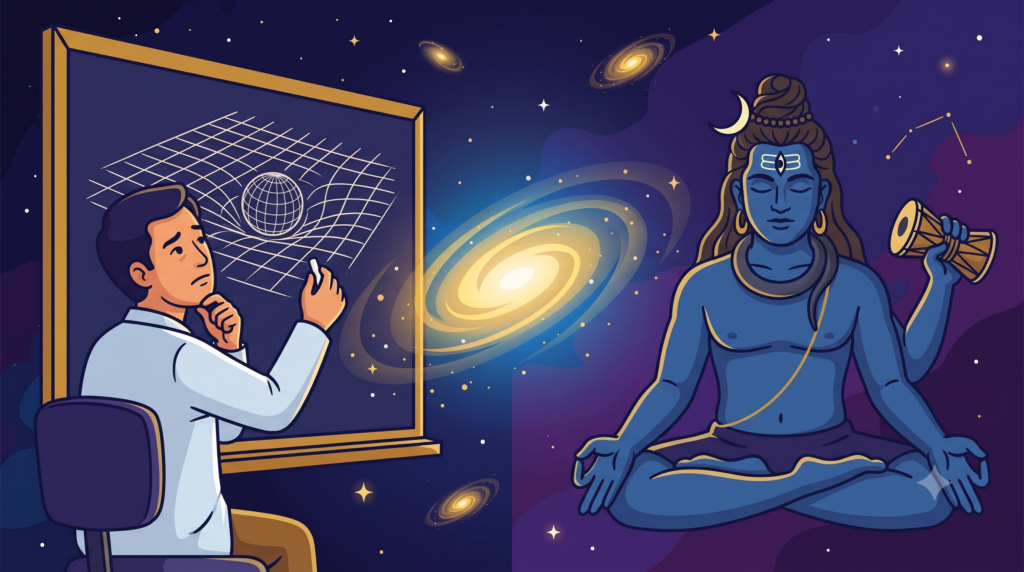
Now come to Mahakala Shiva’s damaru, the small drum he holds, and to two texts most people outside serious yoga circles have never opened, the Nada Bindu Upanishad and the Hatha Yoga Pradipika.
Both describe an inner sound, one aspect of that very damaru, that a practitioner learns to hear through the right ear during dhyana. This sound has a name, Anahata Nada, the unstruck sound. It arises without two things striking each other. This sound is simply there, as it is, untouched, once you know how to listen for it with the organ we have already identified.
Let me share from my own experience and offer it as Shabda Pramana, testimony as a valid means of knowledge. These spanda nada experiences, the felt vibration and the inner sound together, are not myths borrowed from old manuscripts.
They can be cultivated.
I have felt them cultivated. But cultivation demands one thing nobody can skip, and that is sadhana, sustained practice. Reading about Anahata Nada will not produce it. Talking about the vestibular system will not produce it.
Somewhere, you have to sit down, close your eyes, turn your attention inward toward that same inner ear that keeps you balanced against gravity every waking moment, and simply begin. However, this takes a lot of time. If you start today, don’t expect results to come tomorrow or even a year after, just trust mahakala himself. And it’s always better to practice under a qualified guru.
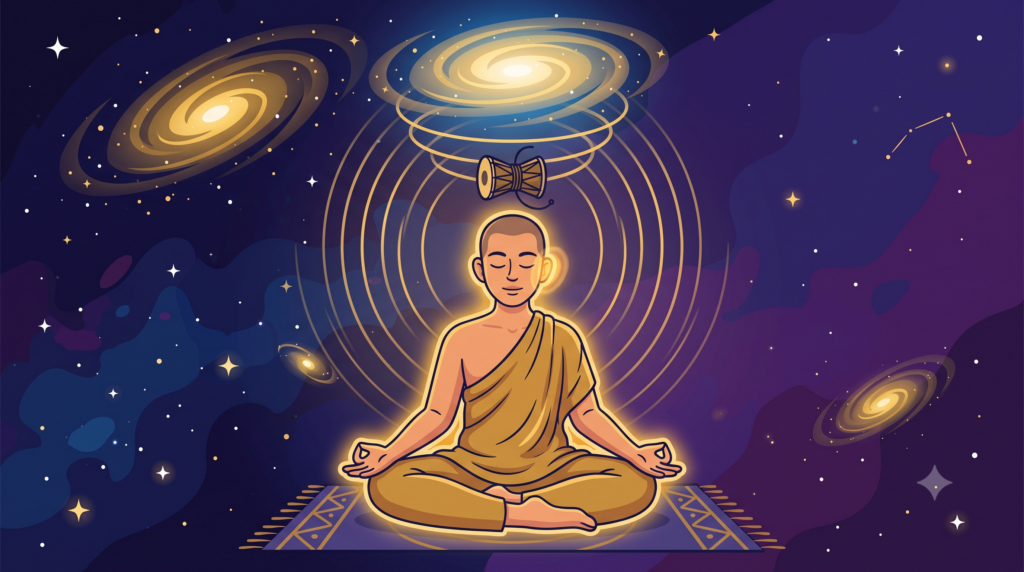
And, this is what phenomenological gravity would be all about.
Gravity is usually taught to us as something entirely external, a force acting on mass from outside, described in equations that never once mention your own body.
But your vestibular system tells a different story every second of your life. It gives you gravity as a felt phenomenon, from the inside, continuously, whether you are conscious of it or not. That felt sense of gravity is not separate from the felt sense of inner sound. They share the same seat inside your skull.
The seers who called Brahman Shabda Brahman may well have been describing exactly this, consciousness recognized first as vibration, and vibration recognized first through the organ that also anchors us to the ground beneath our feet.
And this is also what is mean by the guru within oneself. The translation is “heavy” from which even the gurutvakarshana (gravity) word is made.
We spend so much energy searching outside for someone who will hand us balance, hand us stillness, hand us the unstruck sound. But the structure that already senses gravity for you, that already keeps you upright without asking your permission or your effort, has been sitting inside your inner ear the entire time. It has never once stopped working since the day you were born. Perhaps that quiet, tireless, always balancing presence is the closest thing to a guru that any of us carry inside our own body, waiting only for sadhana to turn its attention inward and let it speak as Anahata Nada.
So the next time someone tells you sound is just vibration in air, or that gravity is just a line in a physics textbook, ask them if they have ever tried listening for it from the inside.
Ask yourself the same question.
Isn’t it worth at least one quiet sitting to find out?