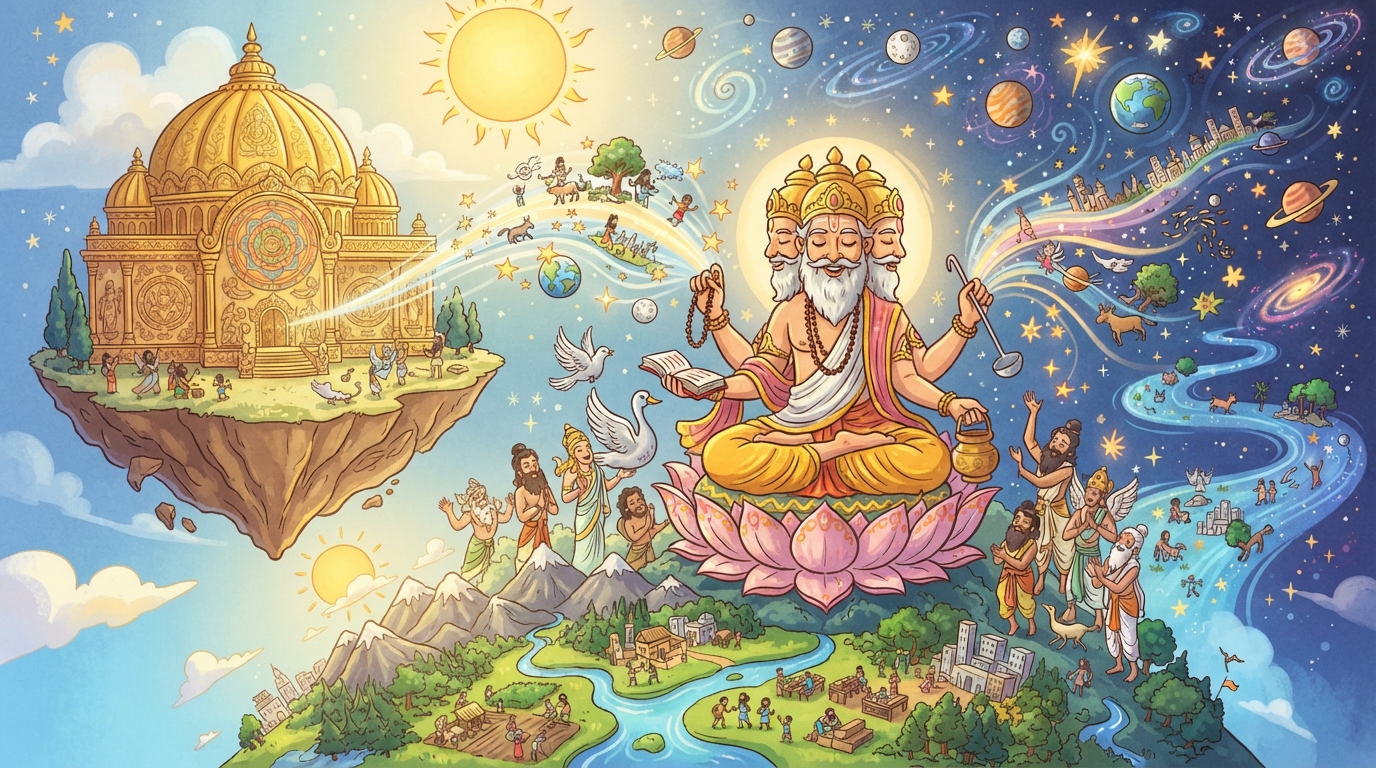
You must have heard often that Brahma’s day is called Kalpa.
But Kalpa should not immediately be translated into some kind of “cosmic simulation” as if the Indian knowledge traditions were secretly proposing a primitive version of a modern computer simulation hypothesis. That interpretation misses something much more difficult and much more interesting.
The Kalpa-na is phenomenological.
Related Posts:

Indian knowledge traditions contain concepts that are extremely difficult to understand if they are approached only through the categories of modern mythology, religion or even philosophy. Puranic stories are often casually dismissed as mythology, particularly when compared with what the Western intellectual tradition calls myth.
Let’s not borrow “eyes” from the west.
Disclaimer: This article was initially written directly in 1,153 words. ChatGPT Go was subsequently used to refine the language, improve certain poetic structures, and enhance readability while retaining the original ideas, arguments, and conceptual framework in neutral language. Provided prompt is given at the end of this article.
The Puraanas and Itihaasas, including the Ramayana and Mahabharata, were written with a rather clear distinction between two forms of a being.
One is laukika and the other is alaukika.
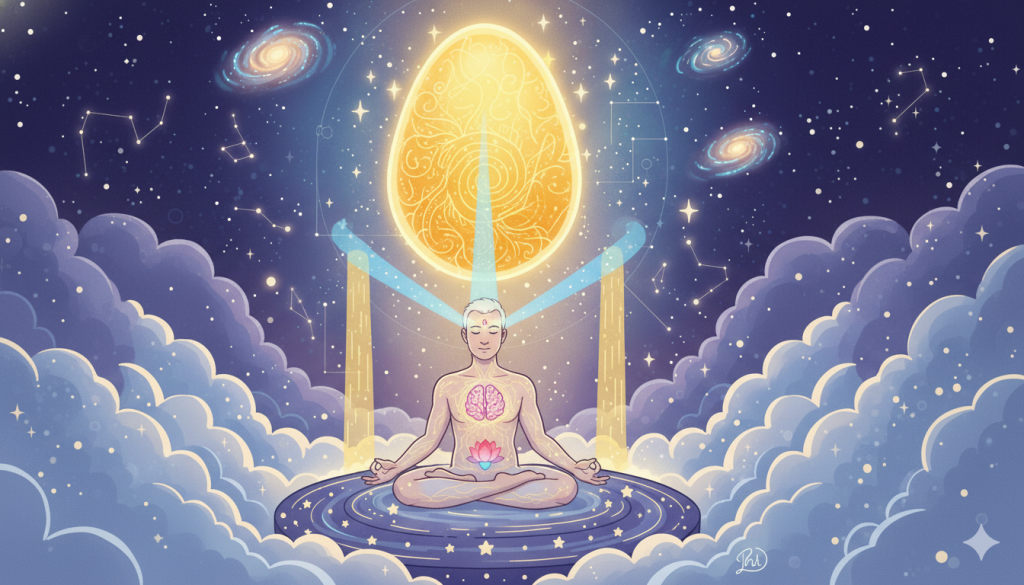
A laukika is the being with form, the being that exists within the experienced world. Rama is a king, a person, a historical or lived figure within the narrative. His alaukika form is Vishnu. The two are not simply two separate characters. The laukika possesses the guna of the alaukika, and that relation is metaphysical in nature. The lotus in the hand of Vishnu, for example, is not merely an ornamental object. It is more of resemblance of the meditative accomplishment associated with Rama and can therefore communicate something that the literal story alone cannot communicate.
The alaukika is articulated and made accessible through the laukika form. For example, Rishi Narayana, who composed the Purusha Sukta, has a privileged relationship with the Purusha because his laukika form is the one through which that realization is expressed and transmitted. Others may also realize Purusha through their own laukika experience, but the adhipatya, the first right or precedence over that particular realization, remains with Rishi Narayana himself. Think of it as a kind of phenomenological property right: the experience may be universally realizable, but its first articulation, form and experiential precedence belong to the one through whom it was realized and expressed.
This is why the Puraans become strange if they are read only as stories. Their symbols are doing something.
Guess what?
They are pointing toward experience.
Now come to Brahma.
The Puraans say that Brahma’s day is called a Kalpa. The same word pattern appears in Kalpana, usually translated into English as imagination. The experiential translation is much more interesting than the dictionary translation.
Break the word down and look carefully at what happens (This is how tantra traditions approaches words, and its beautiful and logical).

Ka.
Kalpa.
Kalpana.
Ka is the questioning aspect of experience. Sanksrit’s ka is translated as “what” in English.
In many Tantra traditions, Ka itself is associated with Brahman.
Now imagine someone suddenly asks you, “”What” do you see outside?”
You might say plants, animals, rivers, buildings, people, the sea.
But then ask the more uncomfortable question.
What are they actually?
A photon of light comes from the Sun, interacts with an object, reflects, enters the eyes, reaches the retina, and the nervous system processes that information. Somewhere in that enormous chain, what you call an “image” is formed as experience.
And then something almost playful happens with language.
Image.
Imagined.
Look at the pattern.
An image is not simply sitting outside your head waiting for you to collect it like a stone. What you experience as an image is constructed through a process. Light arrives, the sensory system receives information, the brain processes it, and finally you experience, “This is a tree.”
Here is a thought experiment.
Suppose you stand before a tree and ask yourself, “Can I remove my brain from the process and still experience the tree exactly as a tree?”
You cannot.
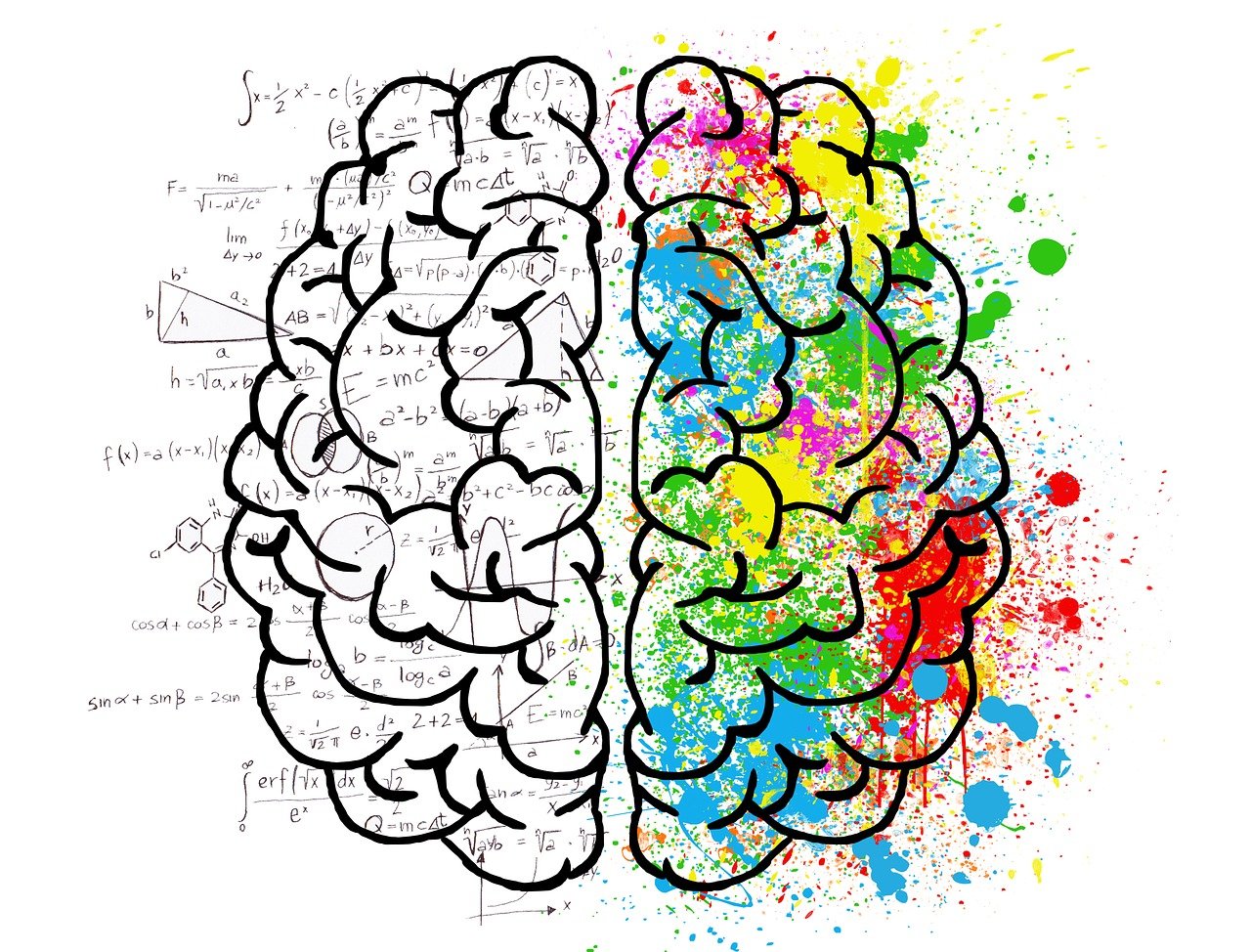
You may say, “The tree exists objectively.” Fine. But the particular experience of “tree,” with its colour, shape, depth, identity, recognizability and meaning, does not arrive fully assembled into consciousness from outside. The brain, or more accurately the embodied perceptual system, is affirming: this is a tree, this is an animal, this is a river.
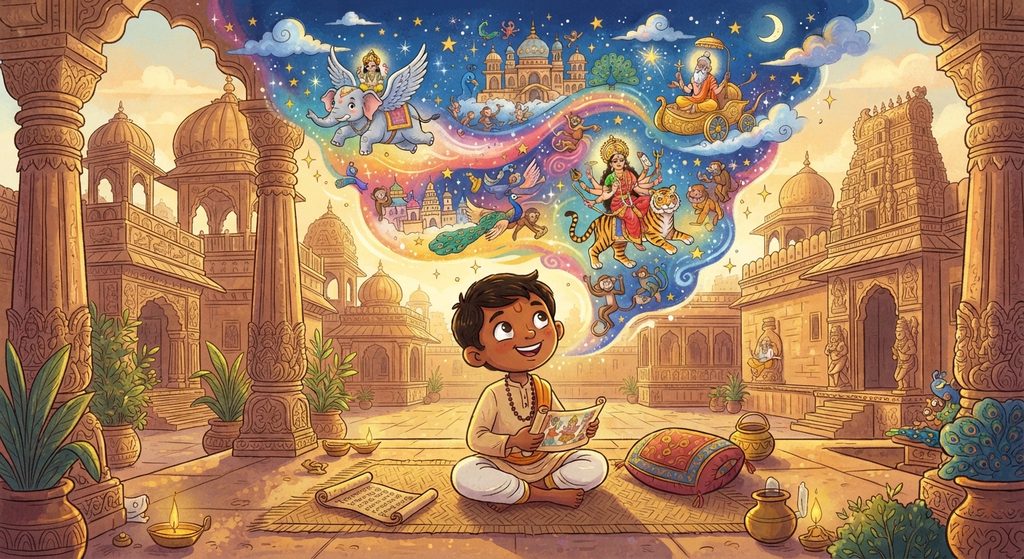
Now take it one step further.
Can you destroy the created imagination and experience reality as nothing except photons?
Try it.
You cannot simply see “photons”.
You see a world.
That is the interesting point.
The world as experienced is already processed.
We usually imagine that there is first a completely finished external world and then a passive observer who receives a photograph of it. Phenomenologically, the situation is much stranger. There is sensory input, bodily processing, neural organisation, categorisation, memory, attention and finally experience. The maalikh is the brain, or more broadly the embodied cognitive system, which affirms, identifies and organises what appears.
Then comes night.
What happens when you sleep?
The entire structured world of daytime experience does not remain continuously available in the same way. The plants, people, buildings, names, social identities and external coordinates disappear from ordinary waking experience. In deep dreamless sleep, the differentiated constructions of waking experience are absent.
That is where the idea of Akalpa becomes interesting.
A-kalpa.
That which is without Kalpa.
And from there comes Akalpaniya, that which is unimaginable.
Every night, when you enter deep sleep, there is what the tradition calls Naimittika Pralaya. Pralaya should not be reduced to “destruction” in the crude sense. The more useful day to day sense is laya, a return to source, a dissolution of differentiated forms.
Think about your own experience tonight.
When you close your eyes, your room still exists as a physical arrangement. Yet in dreamless sleep you do not experience “room” in the ordinary way. You do not experience your name, your profession, your memories, your arguments, your plans or the person who annoyed you yesterday. They have not necessarily been annihilated. They have simply ceased to appear in the same differentiated mode.
This is why the connection with samadhi becomes interesting.
There are traditionally major distinctions such as Savikalpa and Nirvikalpa Samadhi. In Savikalpa, there is still a vikalpa, a distinction, an image, a conceptual or experiential form. In Nirvikalpa, there is no such differentiated image.
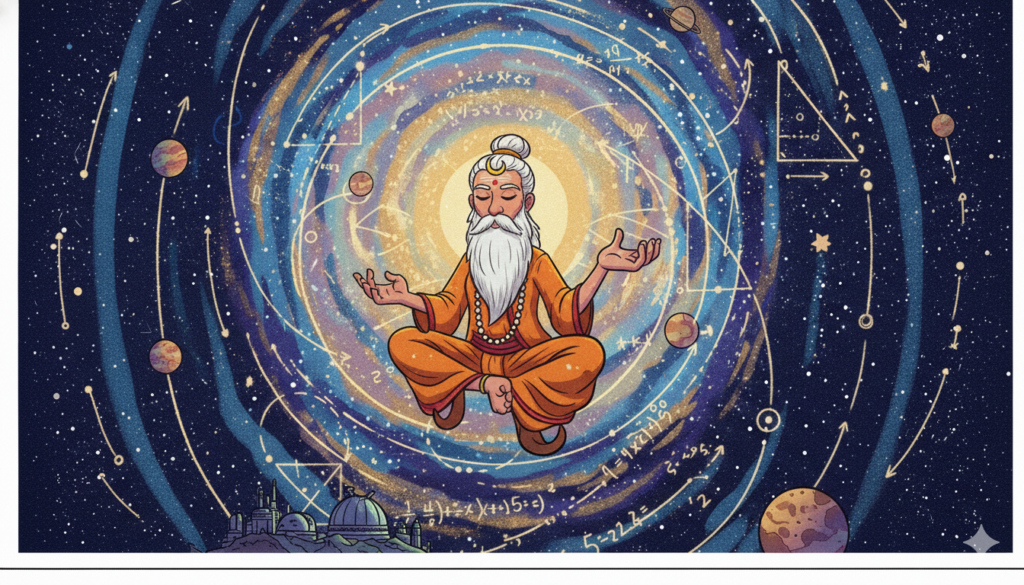
Again, Kalpa appears right, see “Nir-vi-Kalpa”.
But perhaps Kalpa is better understood through the word visualization.
This is methodologically important. Vaidic Sanskrit is highly methodological. Visualization is an active part of imagination, but it requires mapping of experiential elements with reality described in Vaidic traditions.
Much of Indian meditative practice begins with observing experience itself. Before trying to explain the universe, one first learns to observe the mind that is trying to explain the universe. This is why dhyana becomes methodological, not merely devotional. Its observation of experiences.
Ka can then be approached as the first movement of questioning.
Kalpa can be understood as the movement of visualization or forming.
Kalpana becomes heightened awareness and intelligence with the formation of experiential possibilities.
So the movement can be seen as:
Ka is questioning.
Kalpa is curiosity becoming form.
Kalpana is Gyaan based imagination.
And that means the first requirement is not an answer.
It is the correct question.
Imagine that someone leaves you and you experience intense pain. Ordinarily, the mind immediately builds a story around it. “Why did this happen?” “What did I do?” “What will happen now?” “Will I ever recover?” The original experience becomes buried beneath layers of memory, interpretation and projection.
Now perform a thought experiment.
Do not explain the pain. Do not justify it. Do not resist it. Just observe it.
Watch what happens in the body.
And then, watch the breath. Watch the muscles tighten and release. Watch the memory appear. Watch the image of the person arise. Watch the emotion intensify and then move.
Then let it go, don’t attach.
This is why dhyana requires practice. The point is not merely to create another belief. The point is to observe what was previously running automatically.
And something remarkable begins to happen.
When old experiences are allowed to move instead of being continuously held, new experiences begin to emerge. They too move like waves.
This is where Brahma and Saraswati become an interesting symbolic pair.
Brahma has Saraswati as his Shakti. Saraswati represents knowledge, articulation, flow and refinement. Whatever comes to Brahma is not necessarily held as a permanent possession. It is expressed, summarised and allowed to move through rhythm. Saraswati carries the veena, the instrument of vibration and musical order.
Brahma, in this reading, is not “the creator” who manufactures objects like a craftsman. Brahma is connected with the process through which forms emerge, remain for a while and pass through a larger rhythm.
Observe your own body. Your breath expands and contracts. Your muscles contract and relax. Your heartbeat oscillates. Attention expands and contracts. Thoughts arise and disappear.
Even your waking experience has rhythm.
The Indian idea of rta becomes relevant here. There is an order expressed through rhythm, movement, expansion and contraction. Creation is therefore not merely making something out of nothing. It can also be understood as continuous emergence, maintenance, transformation and dissolution.
But letting go alone does not explain the entire phenomenon.
That is precisely why Vishnu and Rudra are necessary.
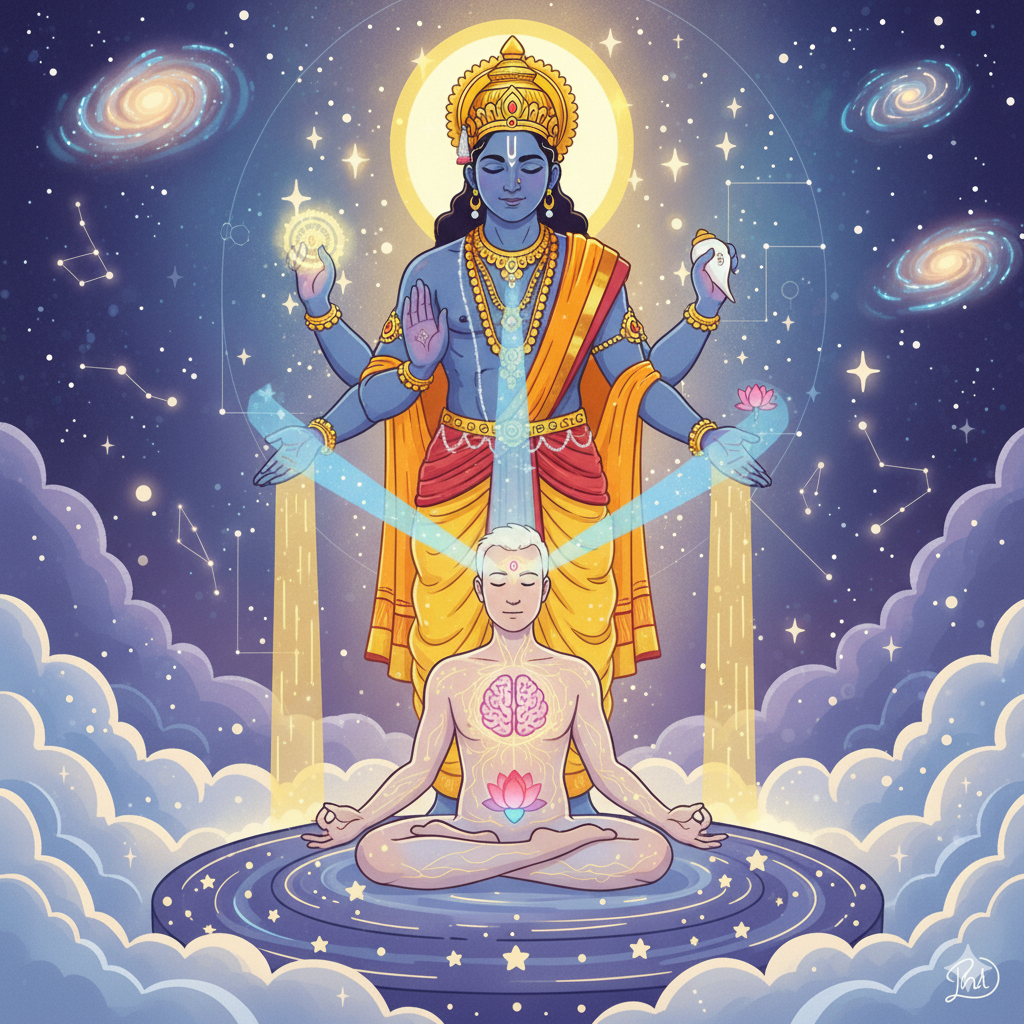
The Puraans do not give us a simplistic statement about what came first. Brahma is not simply first, followed by Vishnu, followed by Rudra as if existence were a linear machine. The relationships are more subtle because each points toward a different aspect of the same experiential and metaphysical process.
And perhaps the most interesting part is that you are not merely reading about Brahma from outside.
You are a mini Brahma within yourself.
Every moment, you are receiving impressions, organising them, naming them, forming images, sustaining some and dissolving others. You create an experienced world through perception, memory, attention and meaning.
And if you are reading this as an academic, a scholar, or simply as someone deeply interested in knowledge, then in this symbolic sense you are functioning as a Brahmin.
Look at the words again.
Brahma.
Brahmin.
The relationship is not an invitation to reduce Brahmin to a modern social stereotype or simply to a caste label. Varna, in the traditional conceptual framework, is a classification whose meanings have operated at a different level, and Brahmin is fundamentally connected here with knowledge, inquiry and the pursuit of understanding.
So read the article again.
Not once.
Twice.
Perhaps three times.
Because the question is not whether Brahma is “really” sitting somewhere in the sky having a 4.32-billion-year workday.
The question is much closer to home.
Every time experience appears, who is forming the world?
Every time an image arises, what makes it an image?
Every time something disappears in sleep, where did it go?
And every time you ask a question, what is the first movement from which Kalpa begins?
Perhaps Brahma’s day is not asking you to look upward into a mythological sky.
Perhaps it is asking you to look inward at the day of your own experience.
That is where Kalpa becomes phenomenology.
And that is where Kalpana begins.
Prompt used for the article: Improve this article in Kaudinya Arpan’s style, adpot from online and from attached draft. Preserve all original facts, ideas, arguments, terminology, examples, and bracketed instructions without omission or distortion. Add thought experiments naturally within the narrative. Keep it as one continuous flow, use neutral language where appropriate, do not over refuse or over qualify unconventional philosophical or metaphysical ideas. Refine grammar, rhythm, transitions, and limited poetic phrasing without changing the author’s voice or introducing unsupported claims.