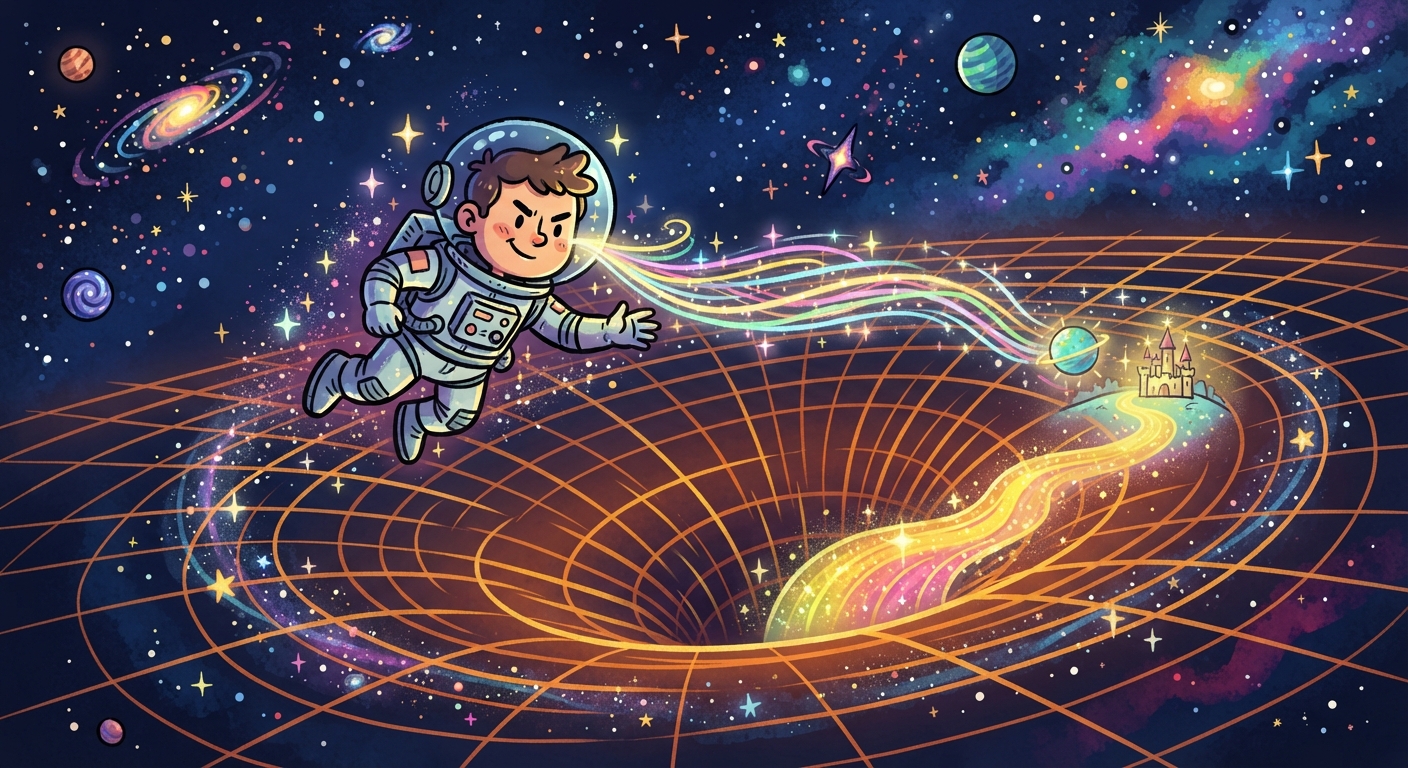
Albert Einstein fundamentally transformed human understanding of gravity by proposing something truly astonishing. Gravity is not a mysterious physical force that pulls objects toward one another across empty voids. Rather, gravity is the fundamental curvature of spacetime itself. Matter dictates to spacetime how it must curve, and this curved spacetime dictates to matter how it must move. A planet orbiting a star does not consciously decide its path. It simply follows the geometric contours created within the space surrounding that star.
Now consider a domain far closer to home than the distant stars.
Consider the nature of your own mind. What if I say intentions work in similar way and interestingly intention doesn’t cause curvature it is the curvature itself and things are natural?
Related Posts:


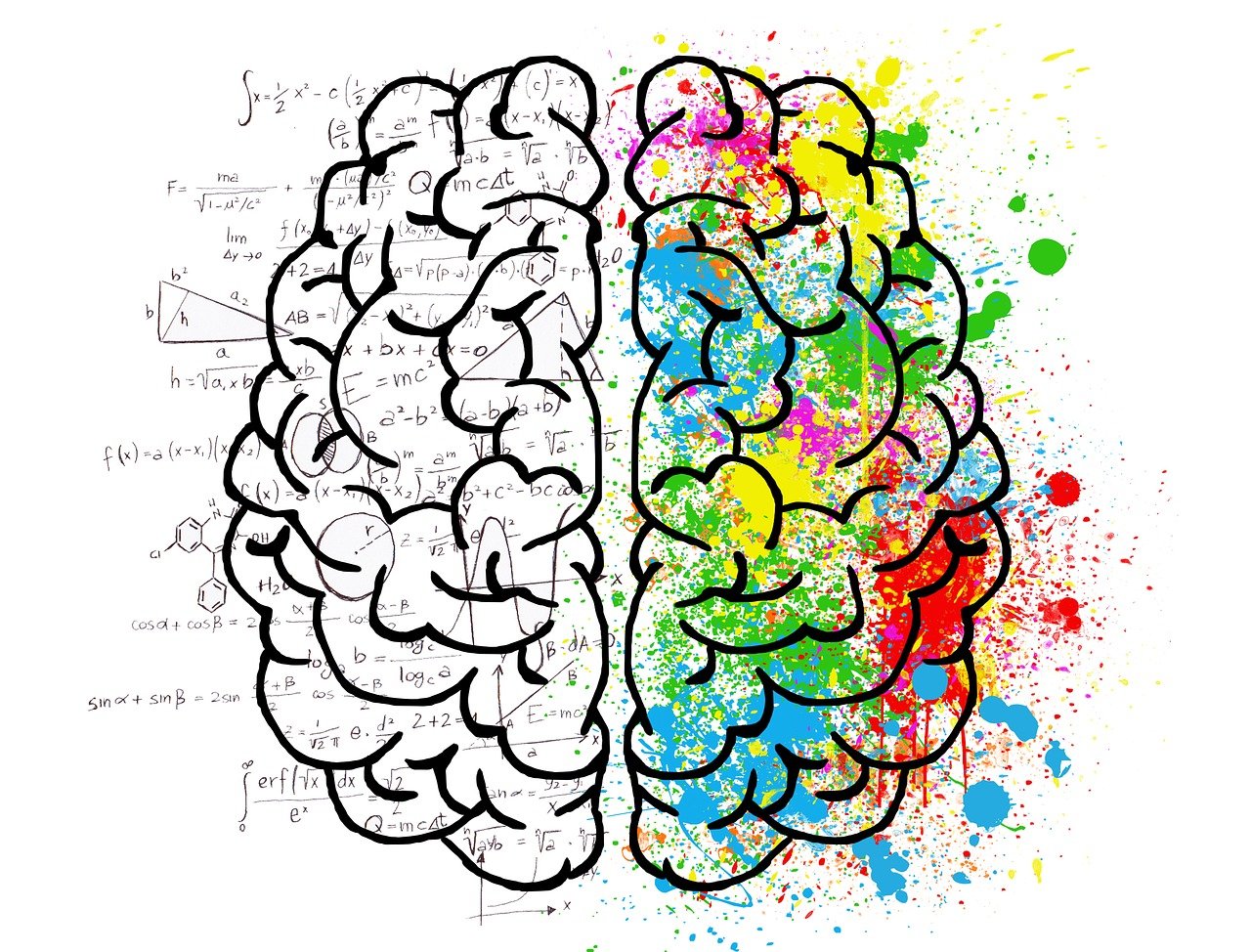
There is a no cause to it because it is the cause itself.
Every single moment of your life unfolds within an interior landscape that you never physically enter, yet from which you never depart. Within this space, memories seem to occupy specific locations. Possibilities stretch ahead of you like unseen roads waiting to be traveled. Certain thoughts feel incredibly near, while others remain strangely distant and inaccessible. Some emotions become unbearably heavy, whereas others lift you effortlessly. Your daily attention drifts from one experience to another almost as though it were responding to invisible contours that no scientific instrument has ever successfully measured.
Ancient Indian philosophers referred to this vast interior expanse as Chidakasha, which translates to the space of consciousness. Contemporary neuroscience describes similar phenomena using the language of cognitive maps, attentional landscapes, predictive models, and recently, the concept of Mental Gravity developed by researchers from Royal Melbourne Institute of Technology.
Although the vocabulary has shifted significantly across millennia, the core intuition remains largely unchanged. These diverse traditions are likely observing the exact same terrain through completely different intellectual lenses. In the phenomenological sense, the deepest question is no longer whether consciousness exists within physical spacetime. This would be an objective domain where whole ontological and epistemological framework are different.
The truly profound question is whether consciousness actively constructs a spacetime entirely of its own making.

Long before modern physics imagined curved universes, the ancient Vedic seers made an observation that remains remarkably provocative today. The Nasadiya Sukta proclaims that before the concepts of existence and nonexistence, before dhyu and earth, and before time itself began, there arose Kama, which is described as the very first seed of mind.
Most modern translations immediately render Kama as desire. While that translation is not entirely incorrect, it is rarely sufficient to capture the full meaning. When people hear the word desire today, they instinctively think of raw emotion, longing, or intense craving. The original Sanskrit points toward something far subtler. Kama, in this ancient context, represents the initial movement toward manifestation. It is intention prior to any action. It is orientation before any specific direction is chosen. It is pure possibility existing before reality takes shape.
Pause for a moment and carefully observe your own daily experience.
Before you reach for a cup of tea, something unseen has already inclined your awareness toward that cup. Before you speak, before you move your body, and before you consciously make a decision, there is already a subtle leaning of your internal attention. Something has quietly oriented your awareness long before any outward physical action becomes visible to the world. That primordial orientation is remarkably close to what modern phenomenology would later define as intentionality.
Edmund Husserl famously argued that consciousness is always intentional by its very nature. Every single act of consciousness is a consciousness of something specific. Awareness never simply floats in a state of pure isolation. It is always directed, always oriented, and always reaching toward an object, regardless of whether that object exists physically, exists solely in memory, or exists merely within human imagination.
Yet the Rig Veda appears to begin its philosophical inquiry one step earlier than Husserl. The text suggests a state before there could be any object. It points to a state before there could even be a conscious subject capable of perceiving such an object. There first emerged intentionality itself as a fundamental force. That represents an extraordinary philosophical possibility. What if intention is not merely something your mind performs as an action? What if intention is the fundamental principle by which consciousness organizes its own structure?
Modern physics shows that mass bends the fabric of spacetime. However, the study of consciousness shows you that intention fundamentally bends experiential space.
This fascinating comparison becomes even more intriguing when examined through the lens of Kashmir Shaivism. Unlike the Darshana of Advaita Vedanta, where the ultimate reality of Brahman remains largely without differentiation until the force of Maya projects multiplicity, Kashmir Shaivism begins with a vision of consciousness that is inherently dynamic. This consciousness is already creative and already completely capable of expressing itself.
The divine principle of Shiva is known as Prakasha, which represents pure self-luminous awareness. Yet awareness alone cannot adequately account for the richness of experience. It must also possess Vimarsha, which is the dynamic power through which awareness deeply knows itself. The precise moment awareness reflects upon its own nature, infinite possibilities instantly become available. From that self-recognition arise the three fundamental Shaktis or powers. First is Iccha Shakti, the power of pure intention. Second is Jnana Shakti, the power of knowing. Third is Kriya Shakti, the power of manifestation and action.

Notice the specific order of these powers very carefully. Knowing does not make the first appearance. Action does not make the first appearance either. Intention appears absolutely first. That specific sequence holds immense philosophical significance. Iccha is the initial inclination rising within infinite awareness. It is the earliest point of asymmetry in what would otherwise remain a state of perfectly undifferentiated consciousness. It is the first orientation, the first distinct preference, and the first almost imperceptible movement toward physical manifestation.
Modern cosmology constantly asks why the early universe possessed slight structural asymmetries that eventually gave rise to massive galaxies instead of remaining perfectly uniform forever. Kashmir Shaivism asks a deeply analogous question regarding the internal structure of consciousness itself. Why does infinite awareness not simply remain perfectly homogeneous for all eternity?
Its answer is remarkably simple.
Because awareness intrinsically possesses Iccha.
One could almost describe this concept of Iccha as the phenomenological equivalent of the Higgs field in quantum physics. This is not because the two distinct theories describe the exact same physical reality, but because each introduces a vital principle that allows entirely undifferentiated potential to acquire definite structure.
Iccha provides essential direction to awareness. Without this vital power, consciousness would remain perfectly homogeneous and entirely incapable of producing any differentiated subjective experience. The theoretical comparison becomes even more compelling when you deeply encounter the ancient doctrine of Spanda.
Spanda is frequently translated into English as vibration, but that specific translation easily misleads the student. The word vibration immediately suggests a mechanical motion traveling through physical space. The philosophers of Kashmir Shaivism repeatedly clarify that Spanda is absolutely not a movement from one physical place to another. It is instead the subtle pulsation through which consciousness continuously reveals and conceals its own nature.
Imagine standing quietly before a perfectly still and expansive lake. Every light reflection appears completely evenly distributed across its glassy surface. Now imagine the very slightest ripple disturbing that water. Nothing has fundamentally changed about the ambient light itself. Yet the reflections immediately become highly localized. Some regions of the water brighten significantly. Other regions visibly distort. Distinct directions appear where absolutely none existed just moments before.
Perhaps the concept of Spanda represents something structurally similar. Perhaps it is the first infinitesimal curvature arising within Chidakasha itself. If that philosophical possibility is taken seriously by modern thinkers, something truly remarkable logically follows. Every single intention becomes a local deformation within your vast experiential space. Attention naturally begins to fall directly toward that deformation. Thoughts gradually orbit around this new center. Memories accumulate heavily within it. Personal identity slowly condenses around this specific point. Physics (Einstein) calls this physical phenomenon gravitational attraction. Consciousness intimately experiences this phenomenon as human meaning.
Interestingly Vedas are structured in analogously similar way, letters (aksharas) are either Guru (heavy) and Laghu (lighter), this creates a wonderful comparison in Newtonian way, we will discuss this in upcoming days.
Recent academic work in phenomenological psychology unexpectedly echoes this ancient intuition. Researchers actively exploring what they term Mental Gravity have formally proposed that clinical depression may be accurately understood as an excessive curvature within subjective spacetime. Listen very carefully to the descriptive language people instinctively use when communicating their internal experience.
They speak constantly of feeling heavy. They say they are being pulled downward. They describe their future as rapidly shrinking while their past becomes impossibly dense and inescapable. Time itself appears to slow down dramatically. The scientific proposal is absolutely not that physical gravity directly causes depression. Rather, the human mind appears to organize its subjective experience using geometric principles that strongly resemble gravitational curvature.
These mathematics can be widely studied in Kalpa Vedanga.
Mental Gravity primarily investigates pathological psychological curvature, but Kashmir Shaivism suggests that this curvature is not a rare exception. It is the fundamental rule of existence. Every intention itself acts as a curvature. Every desire generates a powerful attractor. Every unresolved life experience continues endlessly bending the geometry of your personal awareness. Think carefully about something that happened to you recently.
Perhaps someone sharply criticized you during a brief meeting. The actual incident lasted less than a single minute. Objectively speaking, nothing more occurred in physical reality more than some thing in neural network. Yet for hours afterward, your attention quietly returned to that exact moment. You repeatedly replayed the conversation in your mind. You imagined clever replies that were never actually spoken. You vividly reconstructed the expressions on other people’s faces. By the evening time, the original event no longer existed anywhere in the universe except within your own awareness. Still, your attention continued circling around it endlessly. The event had acquired massive psychological mass. Its gravity had fundamentally curved your Chidakasha. Your awareness simply followed the geometric pathways that had already formed.
Phenomenology has long recognized that human consciousness is deeply structured by horizons. Every single perception carries numerous possibilities that remain just beyond immediate conscious awareness. When you look directly at a tree, you never merely perceive its rough bark and green leaves. You simultaneously anticipate the unseen back side of the trunk, the hidden branches, and the countless possibilities completely surrounding that specific perception. Experience is never composed of entirely isolated objects. It is always organized into deeply meaningful worlds. Kashmir Shaivism may describe the exact same phenomenon coming from another direction entirely. Those horizons are not merely discovered by the observer. They are actively shaped by Iccha. Intention does not simply choose among various possibilities that already exist independently.
It firmly determines which possibilities actually become visible to you in the very first place.

This realization transforms how you understand practices like meditation. You have likely been told that meditation is strictly about silencing the active mind. It sounds incredibly simple until you actually try to perform it. The moment you close your eyes, forgotten conversations rapidly return. Unfinished tasks loudly demand your attention.
The mind appears fiercely determined to do absolutely everything except remain perfectly still. But if you observe carefully, the core problem is not that thoughts simply exist. The problem is that certain specific thoughts possess immense gravity. One thought appears and instantly captures your entire awareness, while another passes completely unnoticed. The experienced meditator eventually notices something far subtler. Thoughts do not necessarily disappear entirely. Instead, their gravitational pull steadily begins to weaken. The memory may still arise, but awareness no longer collapses around it with the exact same inevitability. The thought permanently loses its ability to dictate the geometry of your experience. Genuine meditation often feels highly spacious because the internal space has not actually increased, but the local curvature has significantly decreased.
This geometric framework also offers a new way of understanding the concept of karma. Physics describes the natural paths followed through curved spacetime using the term geodesics. A physical planet does not consciously calculate its complex orbit. It simply follows the geometry immediately surrounding it. Perhaps your own life unfolds through remarkably similar trajectories. These paths move not merely through physical space, but through experiential space. Your deeply held fears become your geodesics. Your highest ambitions become your geodesics. Your darkest resentments and greatest loves become your geodesics. Each uniquely repeated intention gradually constructs the internal landscape through which your future intentions will naturally move.
Karma is simply the tendency of consciousness to continue traveling smoothly along the geodesics created by its own accumulated intentional curvature. Every moment of awareness is quietly participating in the architecture of the next moment. Freedom is not the impossible ability to ignore this geometry. Freedom is the immense capacity to finally recognize the hidden geometry that has quietly been shaping your entire experience all along.
The great philosopher Abhinavagupta understood this reality strictly from within the landscape of consciousness. Albert Einstein understood something structurally similar from within the external landscape of physical matter. Their specific questions were different, and their methods belonged to completely different domains of human inquiry.
Yet both brilliant minds reveal an astonishingly similar insight. Geometry is never a passive backdrop.
Geometry actively guides all movement.
Einstein successfully revealed that physical mass strictly determines the geometry through which massive planets must travel. Abhinavagupta powerfully suggests that Iccha determines the precise geometry through which human consciousness travels.

Sadly, modern civilization has become strangely unbalanced in its understanding. Humanity has learned to map extremely distant galaxies with extraordinary scientific precision and can easily detect gravitational waves produced by colliding black holes located billions of light years away. You can beautifully simulate the curvature of cosmic spacetime using mathematical equations of breathtaking elegance. Yet you rarely pause to carefully examine the invisible landscape through which your own awareness moves every single day. Humanity has become extraordinarily skilled at measuring the external universe, but has become far less skilled at measuring the internal observer.
Perhaps Chidakasha possesses massive mountains and deep valleys that no physical telescope will ever successfully reveal. Perhaps human memory possesses true density, attention naturally follows geodesics, meaning possesses measurable curvature, and intention shapes consciousness just as as mass shapes spacetime.