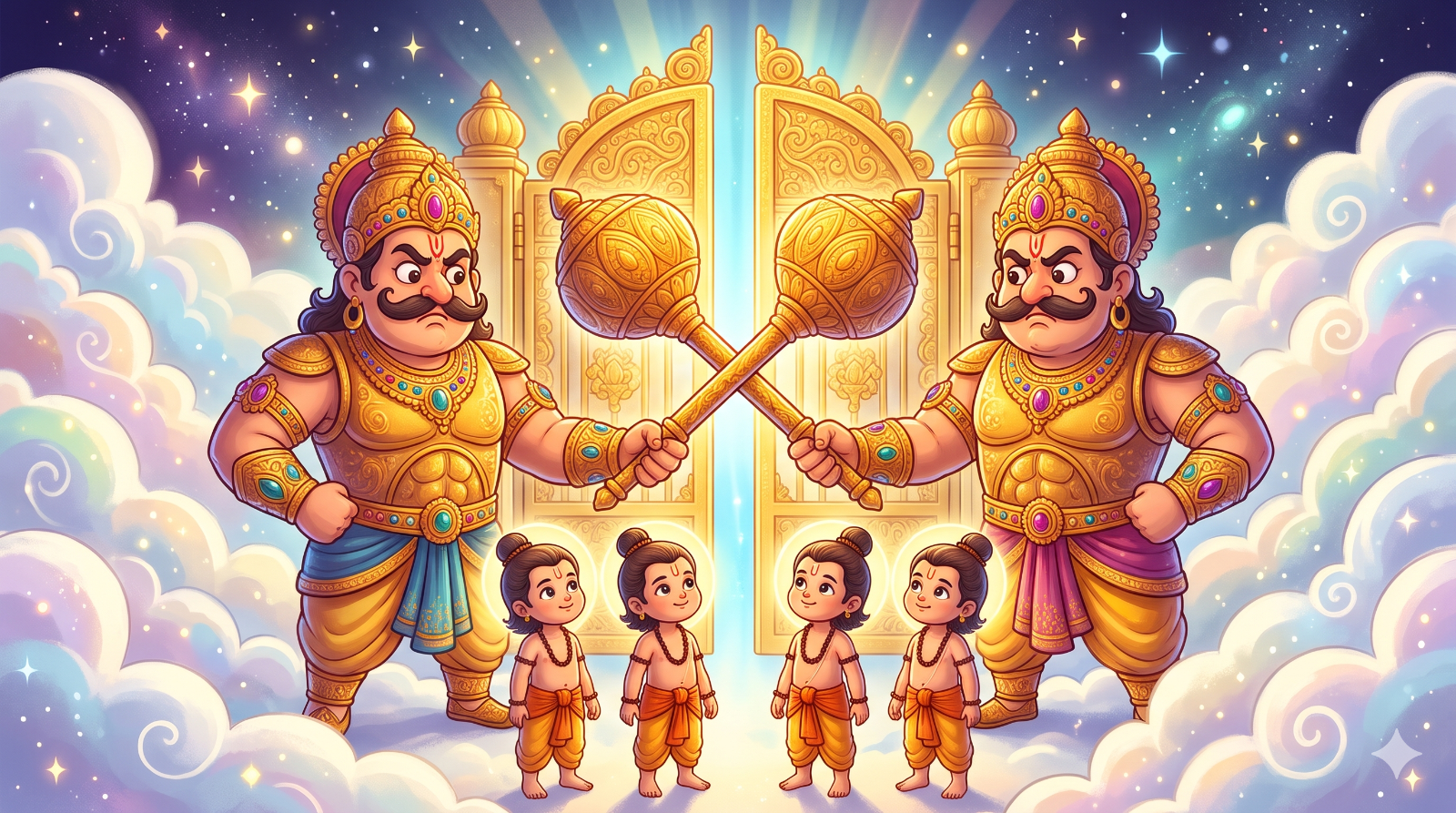
How many times have you heard the Ramayana? Once from a grandmother at bedtime, once on a television screen, once in a katha under a shamiana, and perhaps once more in a novel that promised to tell you “the other side”.
Each one of us has read a version of the Ramayana, and each version leaves us with a face.
So let me ask a simple question. When you close the book, whose face stays with you, Rama’s or Ravana’s?
Related Posts:



These days it is fashionable to stay with Ravana. His scholarship, his ten heads, his Shiva Tandava Stotram, his “misunderstood” pride.
I am not saying Ravana had no greatness. I am saying something more uncomfortable.
If, after hearing or watching the Ramayana so many times, your mind keeps drifting to Ravana instead of Rama, then perhaps you never truly had Bhakti of Rama to begin with.
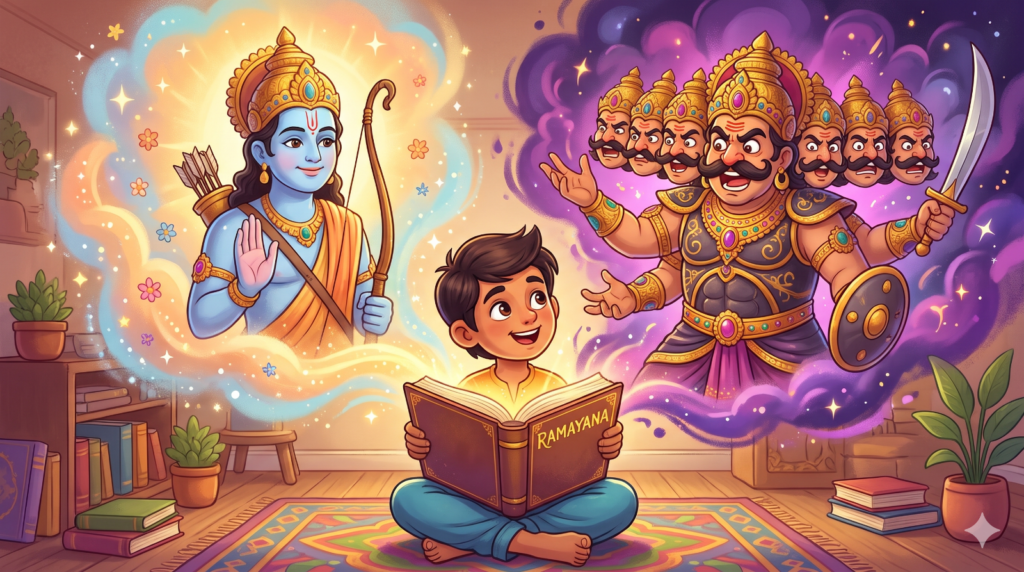
Even Ravana’s own uncle knew better. When Ravana came to Maricha for help in abducting Sita, Maricha, a rakshasa himself, warned him:
rāmo vigrahavān dharmaḥ sādhuḥ satya-parākramaḥ
rājā sarvasya lokasya devānām iva vāsavaḥ“Rama is dharma possessing a body, righteous, one whose valour is truth, ruler of the whole world, as Vasava (Indra) is of the devas.”
Valmiki Ramayana, Aranya Kanda 3.37.13
Now here is the twist the Bharatiya tradition loves. It says Ravana attained liberation at the hands of Bhagavan Rama precisely because he never stopped thinking of Vishnu.
In hatred, in fear, in rivalry, day and night, his mind was on Rama. Narada says this openly to Yudhishthira in the Bhagavatam:
yathā vairānubandhena martyas tan-mayatām iyāt
na tathā bhakti-yogena iti me niścitā matiḥ“As, by being continuously bound through enmity, a mortal attains the state of being made of That, not so by bhakti yoga. Thus is my firmly ascertained understanding.”
Srimad Bhagavatam 7.1.26
Ravana thought of Rama all the time, be it in a negative or a positive way.
So the one who thinks of Ravana instead of Rama is not even at Ravana’s level.
Ravana at least had Rama in his mind.
Isn’t it interesting?
To understand why Ravana was given this strange privilege, we have to go to the doors of Vaikuntha.
The third canto of the Bhagavatam tells how the four Kumaras, Sanaka, Sanandana, Sanatana and Sanat Kumara, came to see Vishnu. They were the mind born sons of Brahma, born before the rest of creation, yet they looked like small children.
The gatekeepers, Jaya and Vijaya, stopped them.
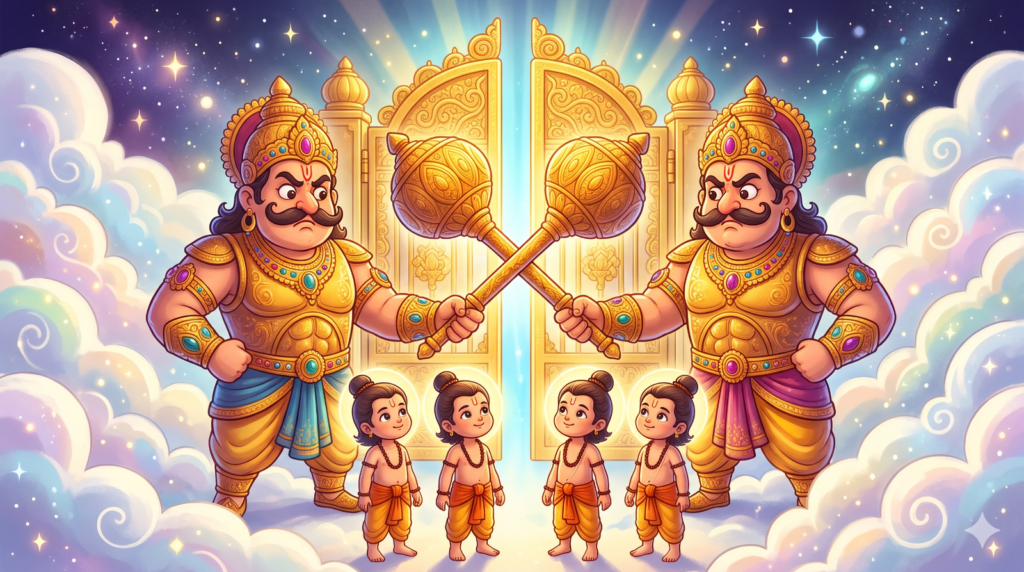
tān vīkṣya vāta-raśanāṁś caturaḥ kumārān
vṛddhān daśārdha-vayaso viditātma-tattvān
vetreṇa cāskhalayatām atad-arhaṇāṁs tau
tejo vihasya bhagavat-pratikūla-śīlau“Seeing them, the four Kumaras, girdled by the wind, aged, of the age of half of ten, knowers of the truth of the Self, those two, whose nature ran against Bhagavan, laughing at their tejas, obstructed them with a cane, they who were undeserving of it.”
Srimad Bhagavatam 3.15.30
The Kumaras cursed them: from now on you will be separated from Vishnu.
And Jaya and Vijaya began to weep, not out of fear of birth on earth, but because they could not bear to be away from their beloved.
Vishnu himself had to come to the door and intervene. A curse once given is never reversed, but the Lord gave them a way through:
mayi saṁrambha-yogena nistīrya brahma-helanam
pratyeṣyataṁ nikāśaṁ me kālenālpīyasā punaḥ“Through union with me by agitated wrath, having crossed over the disregard of the Brahmanas, you two will return to my nearness, in very little time, again.”
Srimad Bhagavatam 3.16.26
The more vivid story is, they were given two options. Seven births on earth as devotees of Vishnu, or three births as his enemies.
Jaya and Vijaya chose enmity, because three lives is a shorter separation than seven.
So they came as Hiranyaksha and Hiranyakashipu, then as Ravana and Kumbhakarna, then as Shishupala and Dantavakra, and each time an avatar of Vishnu came to take them home.
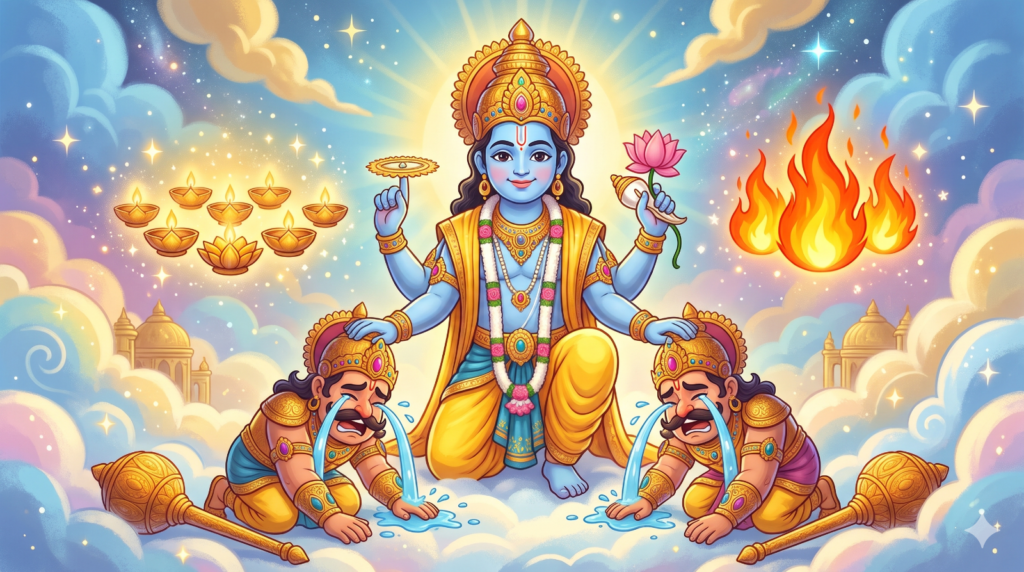
Now look at the names. Jaya means victory. Vijaya means victory with distinction.
Who stands at the door of the divine? Victory does.
Life is all about struggles, and a symbolic victory is always required to reach the divine. That is the meaning hidden in these two names.
But see who comes walking up to that door: Sanat Kumara. Sanat means eternal, Kumara means child. Eternal, childlike consciousness.
When Bhakti arrives in that form, innocent, unarmoured, carrying no trophies, it is just as dear to Bhagavan. Victories still matter, for they are how we struggle our way toward the divine. But the childlike heart reaches the same door by another path. In this story, the victories stood guarding the door and the child still walked up to it. Both belong to Vishnu in the end.
The parallel does not stop with Vishnu. Jaya and Vijaya have a similar role with Narayani.
In the Rudra Samhita of the Shiva Purana, Jaya and Vijaya are the sakhis of Parvati, and it is on their advice that she creates Ganesha to guard her door. A doorway again, a gatekeeper again.
The stories of the divine run in parallel through the Puranas. If you have the Bhagavatam, you will have the Devi Bhagavatam also.
And when we pray to the Devi, the prayer still asks for that same symbolic victory:
rūpaṁ dehi jayaṁ dehi yaśo dehi dviṣo jahi
“Give form, give victory, give glory, strike down those who hate.”
Argala Stotram, recited with the Devi Mahatmya
Notice that those who hate are named in the same breath as victory. Ravana outside, Ravana inside.
And this brings us to the idea underneath the whole story, Karma.
Jaya and Vijaya had to live out their births. The curse did not vanish just because they were dear to Vishnu.
But even Bhagavan is not exempt from action. Krishna says it plainly in the Gita:
na me pārthāsti kartavyaṁ triṣu lokeṣu kiñcana
nānavāptam avāptavyaṁ varta eva ca karmaṇi“For me, O Partha, there is nothing to be done in the three worlds, nothing unattained to be attained, and yet I abide, indeed, in action.”
Bhagavad Gita 3.22
Bhagavan needs nothing, and still he comes down, as Varaha, as Narasimha, as Rama, as Krishna, to claim his victories (Jaya-Vijaya) back.
Jaya and Vijaya do not climb back to Vaikuntha on their own. Vishnu walks onto the battlefield and brings them home himself.
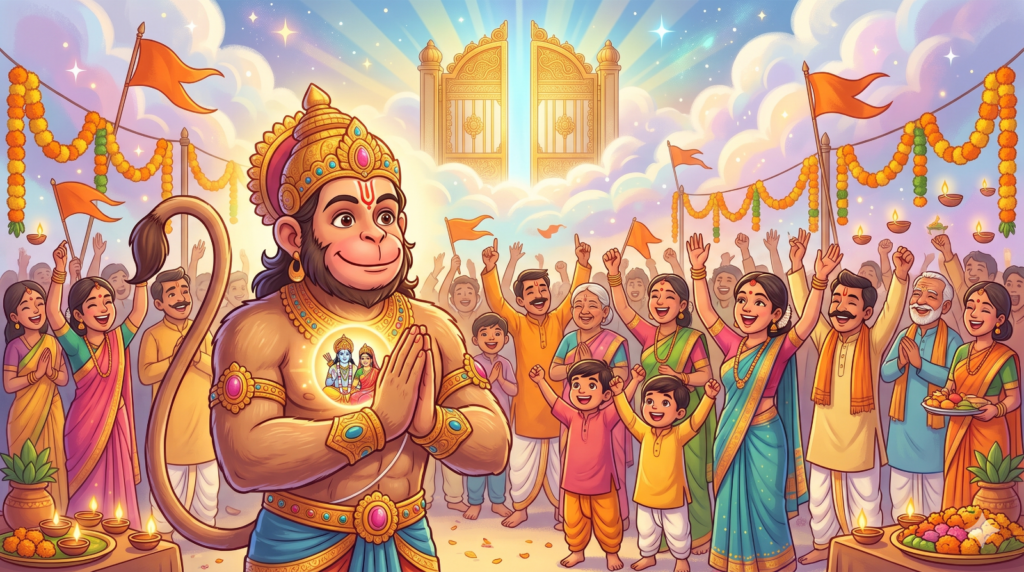
That is why we say “Maha Vishnu ki Jay” and “Hanuman ki Jay”.
Have you ever noticed what you are actually shouting? You are calling Jaya back to the one he belongs to.
And Hanuman is the finest example of all. He too thought of Rama every single moment, just as Ravana did, but through love instead of hatred.
Both minds were fixed on Rama. One burned Lanka, the other ruled it and lost everything. Same absorption, two directions.
So the next time you hear the Ramayana, notice whose face your mind keeps returning to.
If it is Ravana’s, ask yourself honestly whether you are thinking of Rama even half as much as Ravana did.
And if it is Rama’s, then take that childlike Sanat Kumara with you to the door. Victories will come and go. Bhagavan will come down and fetch them.
Isn’t it enough to simply walk up to the door like a child?
Bolo shri Raam ki … Jay