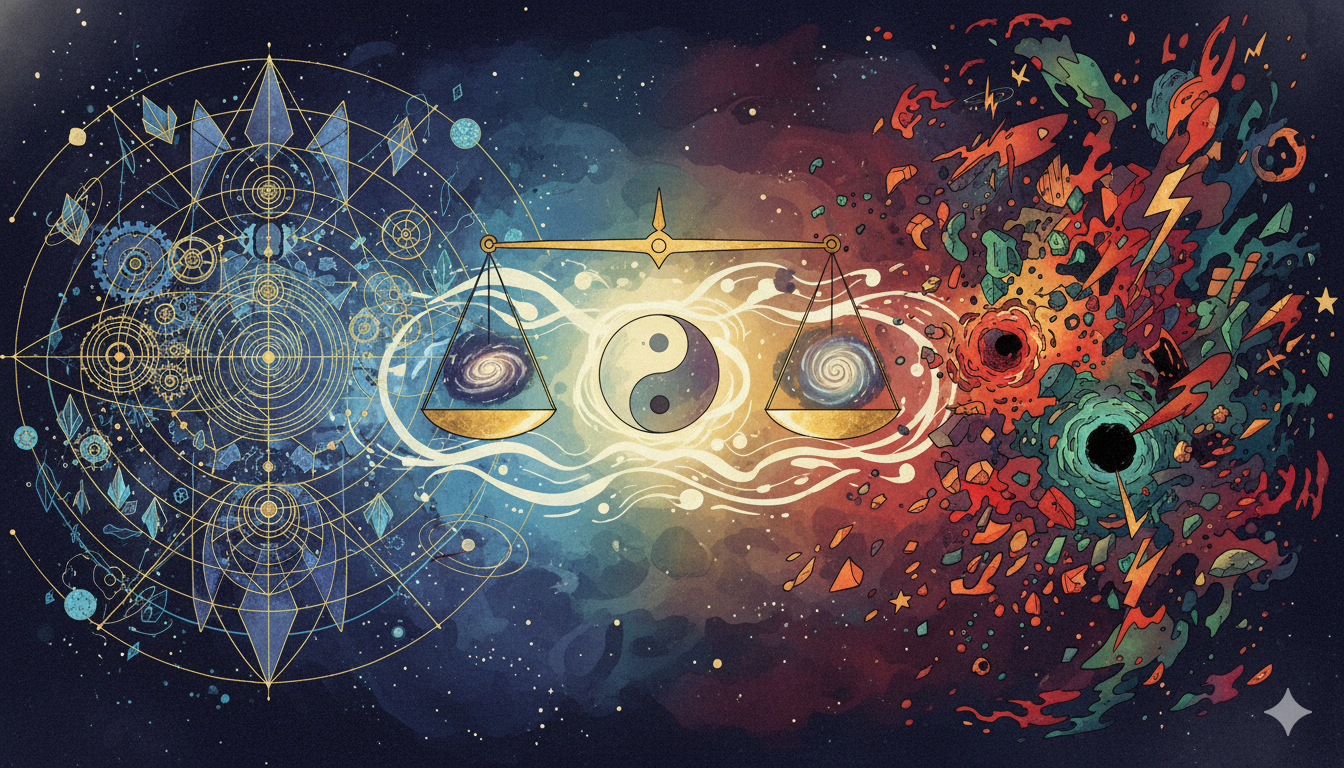
People often mistranslate Dharma as a “religion.” This is, to put it mildly, completely wrong. It’s a linguistic and philosophical blunder that’s caused centuries of confusion. Religion is a framework of belief, usually in a deity or deities… Dharma is something else entirely.
In fact, the highest court of justice in India, the Supreme Court, has also stated this (in the case of Ramesh Yeshwant Prabhoo). The court observed that “Dharma” is not religion but a concept akin to a “code of conduct” or “righteousness.” It’s about holding the social fabric together.
But even “code of conduct” feels too dry, too… bureaucratic.
Related Posts:


The ancient sage Kanada, in his Vaisheshika Sutras, gave a definition that hits closer to the mark. He said:
Yato Abhyudaya Nishreyasa Siddhih Sa Dharmah (यतो अभ्युदय निःश्रेयस सिद्धिः स धर्मः)
“That from which brings about Abhyudaya (material prosperity and well-being) AND Nishreyasa (spiritual liberation or ultimate fulfillment)… That is Dharma.”
See?
It’s not a list of “don’ts.” It’s a system. A system for what?
For successful expansion (prosperity) that also leads to balance (fulfillment). It’s a physicist’s definition, really.
It’s about managing energy.
So what Dharma really is? Let’s try to understand it… from a scientific way.

Before we can even touch Dharma, we have to know Rta, the larger framework it lives in. The common translation is cosmic order.
When one says Rta is the “Cosmic Order,” don’t you think it’s necessary to understand the meaning of “cosmos” first?
But the question again comes… would it be classical physics or quantum physics or both?
Classical physics gives us the beautiful, predictable orbits of planets. Quantum physics gives us the utterly bizarre, probability-driven world of the very small.
If Rta is truly the Cosmic Order, it must be the master principle that somehow bridges both.
Let’s start with the cyclical universe theory. Do you know the oscillating universe theory was briefly considered by Albert Einstein in 1930?
He theorized a universe following an eternal series of oscillations, each beginning with a Big Bang and ending with a Big Crunch. In the interim, the universe would expand for a period of time before the gravitational attraction of matter causes it to collapse back in and… bounce. So that’s like cyclical never ending universe.
Don’t go with these fancy terms. I am 100% sure physicists are bad in naming things. Who names the explosive expansion of all spacetime “Big Bang” and the potential contraction of the universe “Big Crunch”?
(Seriously, though, there’s a good story here. The term “Big Bang” was actually coined by a scientist named Fred Hoyle in 1949. The funny part? Hoyle hated the theory. He used “Big Bang” as a sarcastic, dismissive term to make it sound silly. The name just… stuck. So, my point stands: physicists are bad at naming.)
But leave this, because it’s already named, so we can’t do much.
The Big Bang is essentially the expansion of the universe from a single point of energy. A “singularity.” That’s a word physicists use when their math breaks down, a point of infinite density and temperature. And it wasn’t a “point” in space; it was the point that became space and time. It’s the place where the very words “where” and “when” hadn’t been invented yet.
This “point” was so small, we’d need a microscope that could see down to the Planck length: roughly 1.62 multiplied by 10 to the power of -35 meters (that’s a decimal point followed by 34 zeroes and then 162). But again, if light was not created so how would light also work?
The problem is strange, but the expansion of the universe has a lot of scientific evidences.
In the 1920s, an astronomer named Edwin Hubble (yes, the space telescope is named after him) found that all the galaxies are moving away from us, like dots on an inflating balloon. The light from them is “redshifted,” or stretched out, proving the fabric of space itself is expanding.

Then there’s the afterglow. In 1964, two scientists, Penzias and Wilson, accidentally found the Cosmic Microwave Background (CMB). It’s the “echo” of the Big Bang, the oldest light in the universe, now cooled to a faint hiss of energy barely warmer than absolute zero (the coldest temperature possible).
So, we have this picture of a universe expanding from a single point. But it begs the question, why? What was there “before” the Big Bang?
Do you know our own Rishis (seers) asked this exact question thousands of years ago? They wrote a shukta, the Nasadiya Sukta, the “shukta of Non-Existence,” in the Rigveda. It peers into that pre-singularity “nothingness” with a skepticism that would make a modern physicist proud.
It starts by negating everything:
nasadasinno sadasittadanim nasidrajo no vyoma paro yat (ना सदासीन् नो सदासीत् तदानीं नासीद् रजो नो व्योमा परो यत्)
“Then, there was neither non-existence (asat) nor existence (sat). There was no realm, no sky beyond it.”
It describes a state where there was no death, no immortality. Just… “That One” (Tad Ekam) breathing, without breath, by its own impulse.
anidavatam svadhaya tadekam tasmaddhanyanna parah kinchanasa (आनीदवातं स्वधया तदेकं तस्माद्धान्यन् न परः किं चनास)
“That One breathed, windless, by its own inherent power. Other than that, there was nothing… nothing at all.”
So how did “That One” become “This Many”? How did the singularity… bang? The shukta gives a clue. It says the first seed of creation was desire.
kamastadagre samavartatadhi manaso retah prathamam yadasit (कामस्तदग्रे समवर्तताधि मनसो रेतः प्रथमं यदासीत्)
“In the beginning, Kama (Desire), arose in It. This was the primal seed, the first impulse of the mind (Manas).”
This wasn’t desire for a new phone.
This was Desire with a capital ‘D’. The fundamental will to exist, to become, to experience. This is exactly what Kashmiri Shaivism calls Iccha Shakti, the “Power of Will.” It’s the first ripple in the ocean of absolute consciousness. It’s the impulse that says, “Let me be.”
And who is this Iccha Shakti, this pure, primal will? The traditions identify her as Uma Kumari, the pure, unmanifest potential. And she, of course, is another form of Narayani, the sister-force of Krishna/Narayana. She is the potential for expansion, the thought before the expansion.
So, this “Desire,” this Iccha Shakti, this Kama, is the “primal seed” of the cosmos. This… this is the why of the Big Bang. It’s the why of expansion.
And what did scientists find in the 1990s? That the expansion isn’t just happening; it’s speeding up. There is a force pushing everything apart, faster and faster, which we call Dark Energy.
This isn’t just a coincidence. This Dark Energy is the cosmic expression of that Kama. It’s the will to be playing out on a galactic scale, the very force of expansion itself.

This “Dark Energy”… let’s convert that into Sanskrit.
Kali Shakti right? Remember devi Mahakali?
She is the Shakti (the Energy) of Kala (Time). She is the raw, untamed, expansive force of nature… the action of that original Iccha (will). That’s good nomenclature, actually. “Kaali Shakti” sounds a lot more poetic than “Dark Energy.” One which makes things expand too rapidly. Remember things associated by Kaali, fear, and more importantly, fear of survival? It’s the universe’s ultimate existential drive… the drive to become more.
And there are lot of her forms like compassion, love, giver of life etc. also.
But here’s a thought… this expansion, this Dark Energy, isn’t just chaotic. It’s necessary. Without this expansive force pushing outward, gravity would have just held everything in one big, compressed, boring lump. This Kali Shakti is what creates the space… the “room” for individual things like suns, planets, and even you to form and have an identity.
So she is the creator and the original form of divine manifestation.
But in this universe where Kali Shakti is pushing everything apart with terrifying speed, why do things exist at all? Why are there galaxies? Why are stars clustered together?
In universe to exist, the expansion needs to be controlled for everything, which has been formed. Like galaxies?
So what holds them together?
Again asking, so what holds them together?
If you look at a spiral galaxy, the stars on the outer rim are moving incredibly fast. So fast, in fact, that the gravity of all the visible matter (stars, gas, dust) in that galaxy shouldn’t be nearly strong enough to hold onto them. They should be flung off into the darkness.
But they aren’t.
In the 1970s, an astronomer named Vera Rubin showed this definitively. Her calculations proved there must be… something… else. A massive, invisible “stuff” providing the extra gravity.
We call it Dark Matter.

It’s “dark” because it doesn’t interact with light. It’s “matter” because it has gravity. It is the invisible scaffolding of the entire universe. It’s the “stuff” that pulled the first atoms together and holds our Milky Way in its embrace. It is the Cosmic Conscience, the Great Shepherd herding the unruly, expanding flock of galaxies and giving them form.
It holds things together.
Now, remember the root meaning of the word Dharma? Dharayate Iti Dharmah. “That which upholds is Dharma.”
So interesting, right? The universe’s primary “upholding” principle, the very thing that stops it from tearing itself apart, is this mysterious dark “stuff.”
What if I say that dark matter itself is the order, the Rta, of the universe? What if it wouldn’t exist?
Things would be destroyed by Maahakali, torn apart by the relentless expansion of that Kali Shakti. This Dark Matter… this unseen, binding, “upholding” principle… it’s the Rta. It’s the cosmic order that puts things together, that balances the raw chaos.
Now, think about our human society. We talk about Kali Yuga. This “Kali Yuga” is nothing but a distorted Avatar of that same expansive Kali Shakti. Think of it like a shadow. Jalandhara was a distorted avatar of Mahadeva, born from his rage. So Kali Yuga is the “Jalandhara” of Mahakali… an uncontrolled, perhaps even distorted male avatar of that feminine expansive force? A force that just builds and expands without balance, without the corresponding “upholding” principle?
See the society. How rapidly it has expanded. Uncontrolled population, uncontrolled consumption. The expansion is there, but the order… the Dharma… is missing. Highest expansion was of population which multiplies the problems. Isn’t it?
(There are some latest predictions that populations will slow down, even in India after the 2060s. So is that the end of Kali Yuga? Forget it. That’s not important. The Yuga theory is a controversy in itself. The real Yugas exist within oneself, that’s the first thing to understand. Though, I will leave one article citing the United Nations at the end of the article, please read it in your free time.)
This brings us back to the core idea. The human body is imagined as a universe in itself. Yatha Pinde Tatha Brahmande… As is the microcosm, so is the macrocosm.

Inside us, we have that Kali Shakti. It’s our desires, our ambitions, our will to expand, which all began as that primal Kama.
But we also have our “Dark Matter.”
Do you know even the word Krishna (devata) implies “dark”?
Kali (Dark Energy, Expansion) and Krishna (Dark Matter, Binding) are the two cosmic forces.
The cosmic twins.
Kali, in her form as Iccha Shakti (Uma/Narayani), is the sister of Narayana (Krishna). One is the expansive force, the other is the binding force. One is the void that binds, the other is the energy that fills. One is the grammar, the other is the poetry. You can’t have a universe without both.
This is the great cosmic balance.
When is Krishna “absent”? When is that binding, ordering principle weak? Kali, the raw expansive force, takes over. In the human body, this is when desire becomes greed, ambition becomes hubris, and the person gets destroyed automatically. This is the fact of the nature. This imbalance… this is Adharma. It’s the uncontrolled state of expansive behaviour.
So is the Kali Yuga.
Think about it. When there was no order, when Krishna went, what happened? Women were raped, society was misbalanced, Dwaraka destroyed itself. What happened post-Indian independence moment? Same thing. The order (Dharma) collapsed, and the chaos (Adharma) of Partition erupted.
But what about the other way? What happens when Kaali (the divine feminine, compassion, the creative expansion) is absent or suppressed?
Because Sita and Draupadi (cosmic feminine who were in danger) represents the compassionate aspect of Mahakali or the divine feminine.
What happens when “order” becomes rigid, toxic, and devoid of the feminine? Then Krishna (the cosmic balancing principle) himself has to come to earth to solve the problem. Why did he come? To fight Ravana, who was molesting women. To fight Duryodhana, who assaulted a woman in his court. To protect the compassionate yogis, who had raised their divine feminine, from attacks.

So, balance is everything.
So is Dharma. Dharma is derived from that cosmic Dark Matter, that Rta. It is the human-scale reflection of that great, unseen, binding principle. It is your personal Krishna.
(SSSSShhh let me tell you cosmic secret, Krishna and Kali are same, we will discuss this later or you will find out by yourself in your spiritual journey)
He is the unseen principle in everything. He is the Dark Matter, the Rta, the taste, the light, the very fabric. As he says in the Gita:
raso ‘ham apsu kaunteya prabhasmi shashisuryayoh | pranavah sarvavedeshu shabdah khe paurusham nrishu || (रसोऽहम् अप्सु कौन्तेय प्रभास्मि शशिसूर्ययोः |) (प्रणवः सर्ववेदेषु शब्दः खे पौरुषं नृषु ||)
“O son of Kunti, I am the taste in water, I am the light of the sun and moon. I am the syllable Om in all the Vedas; I am the sound in ether and the ability in man.” (Bhagavad Gita 7.8)
He is the structure. He is the order that holds the rasa (taste) to the water and the prabha (light) to the sun.
Dharma, then, is your alignment with this structure. It’s the invisible integrity that holds you together. It’s the internal “Dark Matter” that allows you to manage your own “Dark Energy”… your desires, your fears, your ambitions… and channel that incredible expansive energy that began as the Kama of the universe into creation (Abhyudaya) instead of self-destruction, leading you to fulfillment (Nishreyasa).
When Krishna says to see him you need “divine eyes,” he’s talking about seeing this order. When he says:
Yada yada hi dharmasya glanir bhavati bharata | abhyutthanam adharmasya tadatmanam srijamyaham || (यदा यदा हि धर्मस्य ग्लानिर्भवति भारत |) (अभ्युत्थानमधर्मस्य तदात्मानं सृजाम्यहम् ||)
“Whenever and wherever there is a glani (decay) of Dharma, O Bharata, and a predominant rise of Adharma… at that time I manifest Myself.” (Bhagavad Gita 4.7)
…he means the ordering principle must manifest to rebalance the chaos.
Dharma is a perfectly balanced state where you are expanding your desires into objects of great creation. It is facilitated by the order in you. What is that order? The Rishis didn’t leave us guessing. They gave us the 10 lakshanas (characteristics).
Dhritih kshama damo’steyam shauchamindriyanigrahah | dhirvidya satyamakrodho dashakam dharmalakshanam || (धृतिः क्षमा दमोऽस्तेयं शौचमिन्द्रियनिग्रहः |) (धीर्विद्या सत्यमक्रोधो दशकं धर्मलक्षणम् ||)
Dhriti (patience, fortitude) Kshama (forgiveness) Dama (self-control) Asteya (non-stealing) Shaucham (cleanliness) Indriyanigraha (control of the senses) Dhi (wisdom, reason) Vidya (knowledge) Satyam (truthfulness) Akrodha (absence of anger) (Manusmriti 6.92)
Look at that list. That’s not religion. That’s physics. That’s the personal “Dark Matter” needed to hold a human beings together and oneself.
Dharma is not a set of rules. It’s the physics of not falling apart. It’s the invisible grace that holds your personal universe together.
Dharmo Rakshati Rakshitah (Dharma protects those who protect it)